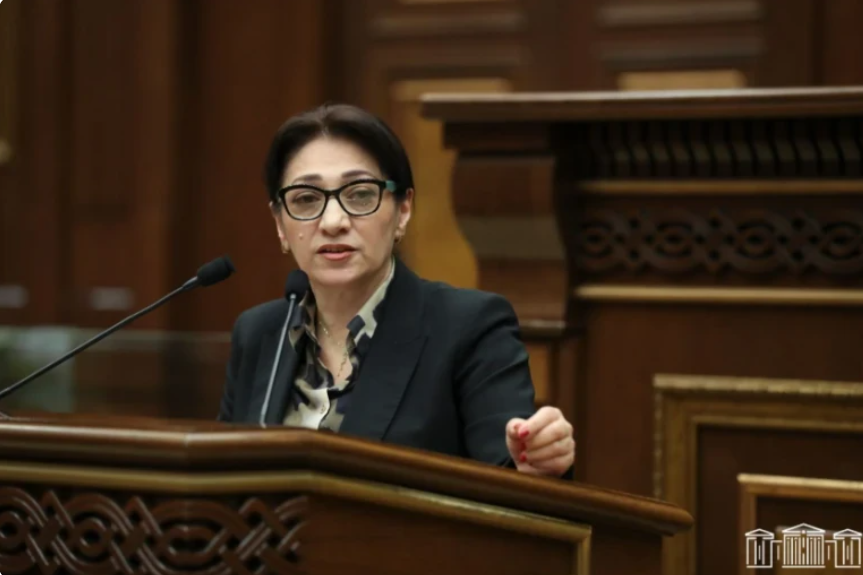
Lilit Galstyan, the chairman of the Standing Committee of the National Assembly for the Protection of Human Rights and Public Issues, appealed to HRD Anahit Manasyan regarding the protection of Armenian prisoners of war. "The other day, another slap-alarm was sounded from the Baku prison by the former Speaker of the National Assembly of the Republic of Artsakh, Davit Ishkhanyan. Until now, Ruben Vardanyan and Davit Babayan have appealed to the RA authorities from Baku regarding humanitarian and other rights issues. The violation of the rights of Armenian prisoners of war held in Baku is limitless, the facts regarding their torture are clear... The protection and security of our compatriots, RA citizens is the constitutional duty of the RA authorities It is the question of the Republic of Armenia and our collective dignity. I addressed the RA Human Rights Defender Anahit Manasyan with an official letter regarding their protection, particularly expecting the answers to the above-mentioned questions. 1. Within the scope of humanitarian law, what actions have you taken to protect the rights of our compatriots? 2. What problems did you raise in your letter to the Human Rights Defender of Azerbaijan and what response did you receive? 3. Are you planning to apply to the Human Rights Defender of Azerbaijan in order to provide them with the judicial acts of our compatriots and take relevant steps to guarantee their fundamental rights? 4. What steps have you taken in the framework of international cooperation to restore the violated rights of our compatriots illegally detained in Azerbaijan and what results have you recorded? Please present the upcoming steps you plan in this direction. Full text of the letter: Dear Ms. Manasyan, 2020 Since the 44-day war unleashed against the Republic of Artsakh, the Republic of Azerbaijan continues to be in captivity with illegal steps and gross violations of international law. To our compatriots. The alarms received from them are terrifying and testify to their cruel, inhumane treatment, torture, and other threats to life and health. Davit Ishkhanyan, the former chairman of the National Assembly of the Republic of Artsakh, who is in Azerbaijani captivity. On September 9, he addressed you and the Human Rights Defender of Azerbaijan with a message, presenting very worrying circumstances. Davit Ishkhanyan reports that he has not received the judgments of the Baku military court, not even the Azerbaijani version, and they have not been published on any website. "ON THE PROTECTION OF HUMAN RIGHTS AND FUNDAMENTAL FREEDOMS" 1950 According to part 1 of Article 6 of the CONVENTION: "Everyone, when his civil rights and duties are determined or any crime presented to him "Regarding the accusations, he has the right to a fair and public trial within a reasonable period of time by an independent and impartial court established on the basis of the law." Article 3 of the same convention stipulates: "No one shall be subjected to torture or to inhuman or degrading treatment or punishment." 2025 since August 22, neither Davit Ishkhanyan nor other prisoners of war have been able to provide a power of attorney to their proxy in the Republic of Armenia so that the latter can protect their interests in Armenia and abroad. He also states that he appealed to you on May 6 of this year, but he has not received an answer to date. RUBEN VARDANYAN In his April 21 message, he asked to consider the possibility of his wife, VERONICA ZONABEND, relatives of other Armenian prisoners of war and you visiting Baku. Davit Babayan also expressed his concern about the ongoing illegal trials in Azerbaijan. on August 19. The UN Committee against Torture in its 2024 resolution on Azerbaijan. In the report, he emphasized his concern about the torture of Armenian prisoners of war. The US Commission on International Religious Freedom in its 2026 stated in the annual report that the Armenian Christian prisoners were subjected to beatings and psychological violence, they were deprived of medical care and proper food, they were denied a supply of Bibles. and the cross tattoos were removed by burning. It should be noted that in 1949, "CONCERNING THE MANNER OF BEHAVIOR WITH THE ARMY" According to Article 118 of the August 12 Geneva Convention: "Prisoners of war are released and repatriated immediately after the cessation of active hostilities." "CONCERNING THE PROTECTION OF THE CIVILIAN POPULATION IN TIME OF WAR" 1949 Part 1 of Article 133 of the Geneva Convention of August 12 also defines: "The detention must stop as soon as possible after the end of hostilities." According to Article 191 of RA CONSTITUTION, Part 1: "The defender of human rights is an independent official who, among other things, contributes to the restoration of violated rights and freedoms." The PARIS PRINCIPLES of the UN General Assembly also define regulations, which are essentially humanistic in their content, aimed at protecting the rights of citizens. Based on the fact that when other channels of cooperation between states are closed, the European Union of National Human Rights Institutions is an important and crucial tool for the implementation of human rights monitoring. Cooperation between ENNHRI. This enables National Human Rights Institutions (NHRIs) to raise concerns about the upholding of human rights standards about the actions of another state by directly addressing that state. to his partner. We should also add that in the European context there are examples of positive cooperation between the IHRCs operating on both sides of the conflict, including the exchange of prisoners, monitoring of places of detention, handling of individual cases. For exchanges, trainings in the field of human rights or submission of reports. Taking into account the above, the clear facts about torture, the alarms of our compatriots, as well as the duty of the public authorities to ensure the respect and protection of the basic rights and freedoms of citizens. � perspective, please answer the following questions: 1. Within the scope of humanitarian law, what actions have you taken to protect the rights of our compatriots? 2. What problems did you raise in your letter to the Human Rights Defender of Azerbaijan and what response did you receive? 3. Are you planning to apply to the Human Rights Defender of Azerbaijan in order to provide them with the judicial acts of our compatriots and take relevant steps to guarantee their fundamental rights? 4. What steps have you taken in the framework of international cooperation to restore the violated rights of our compatriots illegally detained in Azerbaijan and what results have you recorded? Please present your planned upcoming steps in this direction."
Armenia
Lilit Galstyan appealed to HRD regarding the protection of Armenian prisoners of war
Source: KARTSIQ