



A year ago, Armenia and the European Union announced the start of work on a new Armenia-EU partnership agenda, setting more ambitious joint priorities for cooperation at all levels, without providing any additional concrete details. The most important thing in all this information noise spread by the KP and Pashinyan propagandists was that Brussels clearly emphasized that this new agenda is not related to Armenia’s accession process to the EU.
Let’s explain what is really happening.
The Partnership Agenda document, which the government is currently preparing to sign with the European Union, cannot replace the 2017 agreement between Armenia and the EU. The Comprehensive and Enhanced Partnership Agreement (CEPA) signed under the leadership of Serzh Sargsyan, since the CEPA has the force of law, that is, it has been ratified by the national parliaments of European countries, adopted by the European Parliament, signed by their governments, the European Council, and the document presented by Ararat Mirzoyan and others called the “Partnership Agenda” is a document signed between the leaders. That’s all.
This means that the document will be signed by the European Commission on the European side, and by the Armenian government on our side.
This is an important circumstance that must be taken into account in order to avoid manipulation.
The document called the “Partnership Agenda”, no matter how much the authorities inflate it, cannot be compared with the CEPA at all. Such a document has always been signed, including under the previous government of the Republic of Armenia, as Partnership Priorities.
Let me remind you that in July 2018, Azerbaijan also signed the Document on the EU-Azerbaijan Partnership Priorities for 2018-2020.
The CEPA, which has the force of law, sets out the general framework for cooperation in various areas, while the Partnership Agenda document selects topics from this framework and prioritises them. In other words, it is the executive’s prioritisation of the CEPA implementation.
Let’s say that CEPA defines 30 areas to be implemented, and every 3 years governments prioritise which of these 30 topics to focus on in the next 3 years, which areas should receive more funding, etc. And, I repeat, this has always been the case, including during our time in office.
Simply put, CEPA is the law, and the Partnership Agenda document is the roadmap for its step-by-step implementation.
Yes, CEPA contains formulations related to the Artsakh conflict (Artsakh’s right to self-determination, etc.), and I do not rule out that the government will try to include in the Partnership Agenda document a clause that due to the change in the situation, the provisions on Artsakh are no longer relevant, in order to justify themselves later, but this will simply be a dirty “set-up”, because, I repeat once again: CEPA is a law ratified by the parliaments of European countries and the European Parliament, and the Partnership Agenda document will be just a document signed between executive bodies, which will not be ratified at any level and, naturally, has weaker legal force than CEPA.
The government is spreading the news that the Partnership Agenda document will touch upon security issues for the first time, and presents this as progress made by the government in Armenia-EU relations.
This is a complete lie, because CEPA does not have an article on security, but rather two separate chapters and articles arising from these chapters. One chapter is dedicated to internal security. police, rule of law, rescue service, etc., and another chapter is dedicated to external security. foreign policy, defense capability, etc.
In other words, there is nothing unprecedented here. The security component was included in the Armenia-EU relations agenda during Serzh Sargsyan’s tenure. Another thing is that they, like in many other areas, distorted this agenda.
CEPA has a roadmap of what needs to be implemented each year. The government falsely claims that up to 50% of CEPA has been implemented.
It is not about CEPA being implemented by 50%, but about 50% of the activities planned within CEPA being implemented in the past years.
In other words, much less has been done in these years than it should have been, and this 50% refers to the indicators of the reporting period, not to the total volume of CEPA indicators.
As for visa liberalization, such a promise exists, but in 2017… In the 7.5 years since the signing of CEPA, this government has not lifted a finger, even deviating from the legacy left by Serzh Sargsyan. During these years, the dialogue on visa liberalization should have started long ago.
Moreover, in November 2017, when the Agreement on Mutual Understanding and Partnership (CEPA) was signed in Brussels in the presence of President Serzh Sargsyan, I was there, and European officials predicted that within 2-3 years, that is, by 2020, a dialogue on visa liberalization with Armenia should have begun. However, it began 5 years late, in 2024-2025.
Even Armenian officials say that the issue of visa liberalization will take at least another 5 years. I assure you that this process will actually take much longer, not only because of domestic political events and political problems in the European Union, but also because of the incompetent, ineffective style of work of the Armenian authorities. The question of starting a dialogue on visa liberalization may be a political decision, and the EU made a political decision to encourage Nikol Pashinyan to participate in the European referendum project here, but the final decision on visa liberalization cannot be political in itself, just as the final decision on membership in the European Union cannot be purely political.
It must be a merit-based decision, and no matter how much European officials want to do Nikol a favor in the PR sphere, such final decisions cannot be implemented through political influence, since there are clear standards that are observed even for the Balkan countries or Moldova and Ukraine.
As for the “GSP+” obtained during the rule of Serzh Sargsyan, Armenia used the “GSP+”. This regime implied zero customs duty for about 6,000 items of goods when supplying Armenian goods to the markets of the EU countries. We used this regime, we worked very normally, of course, not with all types of products, because, naturally, we did not have 6,000 items to export, but we used about 2/3 of them.
Having come to power, they started playing with the exchange rate. It is no secret that the exchange rate is artificially low. When they strengthened the dram, our GDP grew purely in digital terms, and “GSP+” works for countries that are in a certain economic development group, that is, in the low-income group. We were included in this group according to the classification of both the World Bank and other financial institutions.
In a good sense, Armenia has always been a leader in the group of low-income countries.
After seizing power in 2018, they artificially strengthened the dram, our GDP grew with a purely mechanical conversion into dollars, and for 3 years in a row, due to their statistical games, Armenia ended up on the list of middle-income countries to which “GSP+” does not apply. In other words, they have been drawing statistics for 3 years in a row, and the EU, seeing that Armenia is no longer a low-income country, but a middle-income country, has deprived Armenia of the GSP+ regime.
The GSP+ regime no longer applies to trade with Armenia, because, according to the false statistics compiled by Nikol, we are a country with a medium, not a low GDP. According to my most conservative estimates, Armenia suffers losses of about 100 million euros annually because of this.
Here is what you need to know about this incompetent, illiterate government and its cooperation with the EU.
In fact, there is a realistic, mutually beneficial, non-adventurous agenda for Armenia-EU relations, there is work to be done, there is a front of work, both through the reforms recorded in CEPA and the new ones
initiatives, for example, by building a full-fledged nuclear power plant by joining the Southern Green Energy Corridor.
PS: While I was preparing this report, news broke that Brussels had decided to create a new instrument to ensure Moldova’s European integration: the Reform and Growth Fund. And huge funds are being allocated for these purposes – about 1.9 billion euros (about 400 million in grants and 1.5 billion in loans). This is proof of the real process of European integration. In our case, they are not preparing French pancakes with Armenian filling for us, but Turkish doner kebabs.
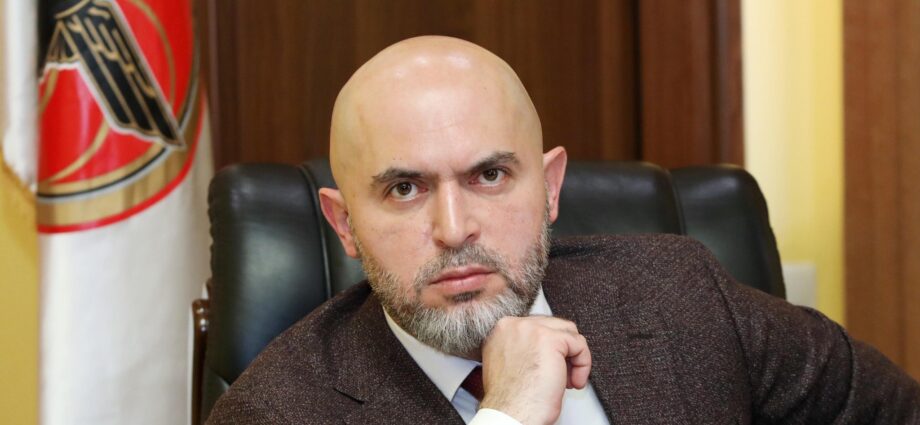
Armen Ashotyan
Vice President of the RPA
TKU “Dzoraghbyur”
2025-04-23