



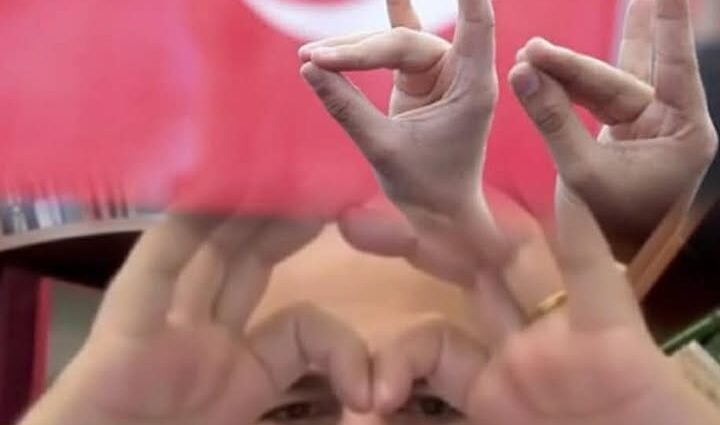
Recently, symbolic gestures used by government circles have become the subject of active discussion on social media. This includes the famous “heart,” which government representatives display at public meetings and are seeking to make their campaign symbol. Some users point out that this gesture, in some cases, resembles the well-known emblem of the Turkish extremist organization Grey Wolves.
According to circulating comments, the issue is not just a matter of superficial similarities. Many note that the problem lies primarily in the general political perception of the government. If someone were to make such a gesture under normal circumstances, it might not attract any attention. However, in the context of the actions and statements of the current government, even such minor details are beginning to be seen in a different light. In recent years, public discourse has frequently voiced accusations that certain government actions and statements are too closely aligned with the interests of Turkey and Azerbaijan. Against this backdrop, some social media users have begun to take a more critical view even of gestures that government officials present as simple and innocuous symbols.
Many users note that while in some cases such similarities may even be coincidental, the problem lies in the already established political perception. They believe that for a significant portion of society, the government’s image has gradually acquired an overly pro-Turkish slant, and therefore any such detail, be it a word, a move, or even a gesture, is immediately perceived in this context.
In this context, social media users often remind us of another case: the symbol of the KP party. The party’s logo is similar in appearance to the logo of a Turkish party and appears to have been borrowed from it. Although government officials do not respond to such comparisons, after each pro-Turkish move, the topic periodically returns to public debate.