



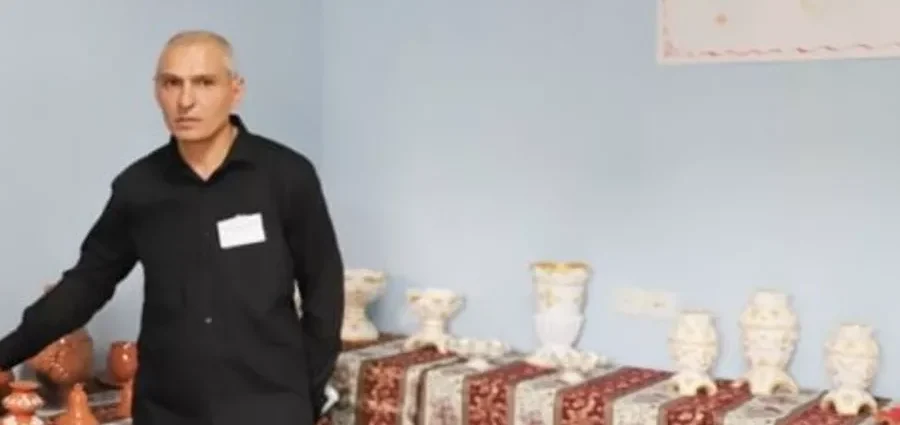
On November 19, 2024, the Center for Legal Initiatives received an open letter from Aram Arakelyan, a life-sentenced prisoner at the Sevan Penitentiary, in which he announced that he was going on a hunger strike, also refusing to take the medication that ensures his vitality.
The statement released by Knetron also states: “The reasons were related to the change in the security zone and dissatisfaction with his early conditional release. On November 21, 2024, the organization was informed that the convict had ended the hunger strike. However, the study of the information collected by the organization showed that the decision to end the hunger strike was not due to the resolution of the issues indicated in the open letter, but to the fact that the refusal of medication led to the deterioration of the convict’s health, due to which, according to the information provided, the latter began receiving treatment and has now somewhat recovered his health.
The organization appealed to the Ministry of Justice, requesting clarification on a number of issues raised by the convict in an open letter. The open letter stated that in 2024, during the examination of the issue of the convict’s conditional early release, the Probation Service presented to the court the opinion of the victim’s legal successor, who died in 2021. In addition, the Probation Service presented new legal successors. In this regard, the Ministry of Justice informed that the report of June 14, 2024, submitted by the Probation Service on the conditional early release of Aram Arakelyan from serving his sentence, stated that the victim’s legal successor K.A. died on September 28, 2021, and S.H. died in 2003. As for the insistence on including the position of a person who is not a legal successor in the report, the ministry informed that the position presented by N.A. was noted not as the legal successor of the victim, but as the position of a relative of the legal successor of the victim.
A detailed analysis of the Criminal Procedure Code makes it clear that there is no legislative norm by which any person can be recognized as a victim instead of the legal successor of a deceased victim, therefore it is not logical, moreover, it contradicts the current regulations that the position of the relative of the legal successor of the victim was included in the report.
The convict is currently serving his sentence in the medium-security zone of the “Sevan” penitentiary. The institution gave a positive conclusion on the mitigation of the conditions of serving the sentence, namely, the transfer from the strict conditions of a low-security zone, but the placement commission operating in the central body of the Penitentiary Service has repeatedly rejected the convict’s petitions for the mitigation of the conditions of serving the sentence. The Ministry reported that the placement commission finds that the resocialization work carried out with the convict and the study of his behavior should still be carried out in the mild conditions of a medium-security zone. By refusing to transfer him to a low-security zone, among other circumstances, the riskiness due to the nature and dangerousness of the crime committed by the convict was taken into account, the need to observe and predict behavior due to such risk in different areas, the risk of recidivism and transfer to a lower-security zone, the need for an objective assessment of the assimilation of values and norms accepted in society through resocialization, the peculiarities of the low-security zone (being in the nature of preparation for release from punishment, creating even broader, everyday conditions for direct contact with society, reducing the intensity of behavioral control, leaving the penitentiary institution without intensive supervision, for example, through long-term trips, establishing free contacts). In connection with the above, we are concerned about what work is currently being done with the convict to assess and reduce the riskiness due to the nature and dangerousness of the crime committed by the latter, to observe and predict behavior due to such risk in different areas, the risk of recidivism and transfer to a lower-security zone. assessment and reduction, towards the formation of an objective assessment of the assimilation of values and norms accepted in society through resocialization, which can fully guarantee the person’s compliance with the characteristics of the low security zone, namely, having the character of preparation for release from punishment, creating even broader, everyday conditions for direct contact with society, reducing the intensity of behavioral control, leaving the penitentiary institution without intensive control, for example, through long-term trips, establishing free contacts.