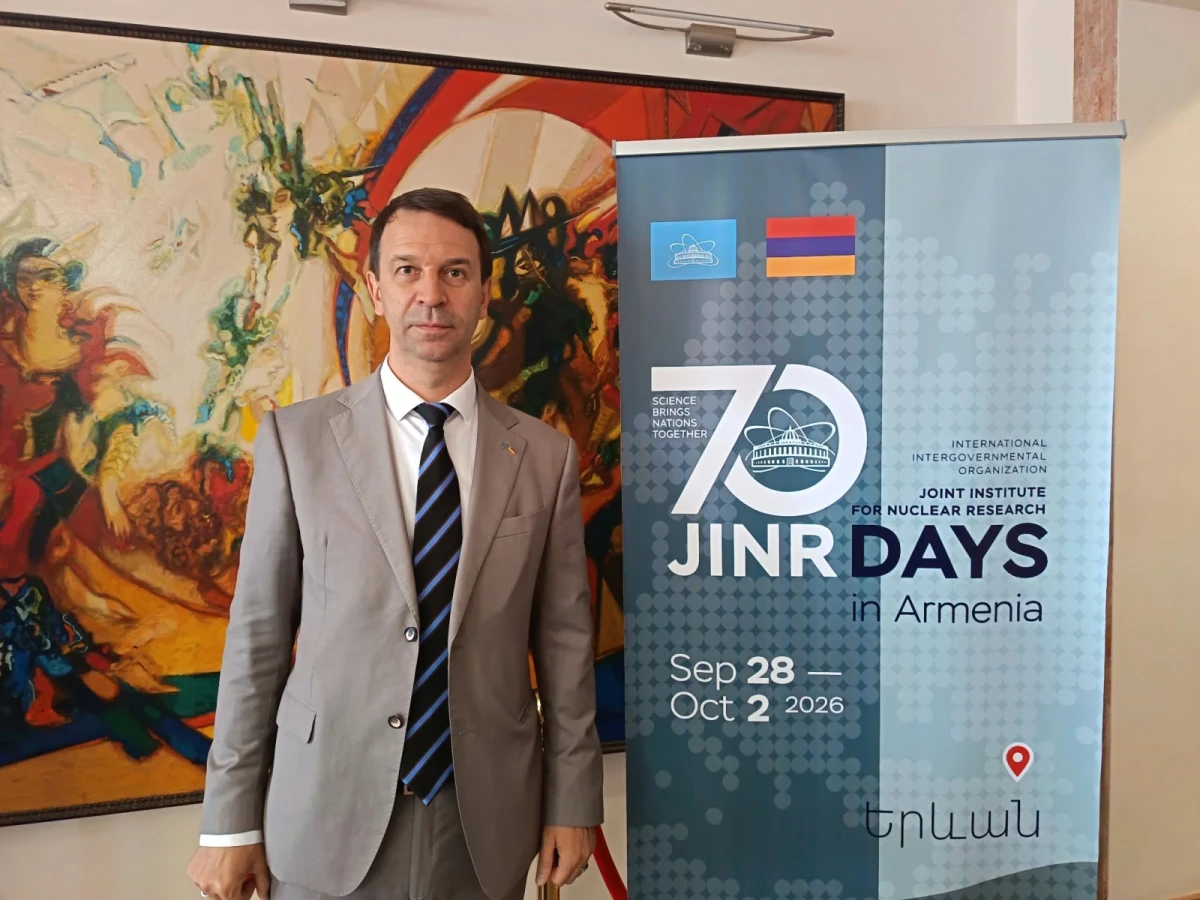
The cooperation between Armenia and the Joint Institute for Nuclear Research (JINR) started with cosmic ray physics and gradually developed into a network of about 20 joint projects in nuclear physics and computer science. �to ecology, medicine and new materials. Grigory Trubnikov, director of the MHRI, believes that the main resource of this cooperation is not only equipment and technology, but also people. Armenian young scientists get the opportunity to use a large international infrastructure, after which they can bring this experience to their homeland. Today, not only high-energy physics connects MHRI with Armenia. Research in joint projects Researchers analyze soil contamination, build computing power, work on medical and pharmaceutical technologies, and train a new generation of professionals. It all started with cosmic rays Wall of cooperation The situation, as Trubnikov told, begins in the 1960s. One of the first directions became high-energy physics, in particular, cosmic ray research and the work of the Rogachev Observatory. Then everything Theoretical physics took an important place. And today it is theorists who remain one of the main links of cooperation between Armenia and Dubna. The reason is quite material. you don't need huge equipment for theoretical work. A scientist needs a computer, paper, a pen, and an environment where ideas can be discussed calmly. According to Trubnikov, they are able to create such an environment in Yerevan, so here it is International conferences and scientific forums dedicated to theoretical physics, mathematical physics and computational methods are held regularly. Later the collaboration also extended to experimental nuclear physics. In the late 1960s and in the early 1970s, a large scientific infrastructure appeared in Armenia: the Yerevan Institute of Physics, now A. on the basis of the Alikhanyan National Scientific Laboratory. MHRI participated in the creation of the accelerator and related equipment. Since then, the scale of interaction has changed greatly. If you can work together before If hundreds of specialists participated, today the cooperation has become more targeted, but at the same time it covers significantly more scientific fields. Twenty projects from nuclear physics to ecology Now the ICRC and Armenia Yerevan State University, National Polytechnic University of Armenia, Armenian-Russian University, A. Alikhanyan National Scientific Laboratory and several institutes of the National Academy of Sciences. According to Trubnikov, there are about 20 joint projects. Their topics are considerably broader than the conventional idea of a nuclear institute It's mine. These are material science, computer science, nuclear physics, medicine and biology, virus diagnostics, pharmaceutical technology and drug delivery systems. There is also a project where kernel This physics is used to solve a rather mundane problem: ecological monitoring of Armenia. Scientists collect plant and soil samples in the country and then analyze them in Dubna using activation analysis methods and � through electron beams. Research allows to determine the content of heavy metals, radioactive substances and other pollutants. Such data are needed not only to capture pollution; with the chemical composition of soil and water, one can try to identify its source, and then use the information, for example, in planning agricultural operations and choosing appropriate growing technologies. In this case, fundamental phys It becomes a purely applied problem-solving tool to understand what is happening in the environment and make decisions based on measurements. Access to infrastructure that does not exist in the country According to T., one of the main results of cooperation Ubnikov is training personnel. Every year dozens of students from Armenian universities come to Dubna for internships, summer and winter schools, diploma projects and other educational programs. MHRI allocates grants for them. Moreover, according to the director of the institute, the level of preparation of Armenian students is quite high. In many ways, this is due to the fact that thanks to joint programs, young people start doing science in the third or fourth grade. in courses. Therefore, when they arrive in Dubna for the diploma project, they are not just students, but novice researchers, familiar with real scientific work. It is especially important for them to have access to such an infrastructure that Ha� It just doesn't exist in heaven. Armenia, as a member country of the ICHR, can use the institute's international research base, and young specialists work there together with colleagues from different countries. "They are this international soup "They get very good training and qualifications," says Trubnikov. Moreover, it is not only about physicists. The international environment allows young professionals to learn to work in large scientific collaborations The result does not depend on one researcher or laboratory, but on teams from different countries. Why do talented people still go to physics, even though there are more profitable professions? Today there is an obvious problem. fundamental physics requires long study, complex mathematics and a lot of research work, while its financial benefit is not a nail. However, Trubnikov does not think that the interest of young people in this field � Disappears. According to him, about a thousand young people from different countries come to Dubna every year: students, masters, postgraduates and beginning scientists. Some come for a week, some for a few months, some for a diploma or a science school. do In the end, about 30-40 people remain to work in the institute. About the same number return to their countries and continue to do science there. This situation shows that basic research is still capable of writing to young people, although not all of them end up in science. There remain, first of all, those strong young scientists who are attracted by big problems. "A really talented person is ambitious, and he wants to leave his mark on this earth." For a physicist, such a problem might be trying to understand the origin of the Universe, the nature of matter, or the structure of the fundamental laws of nature. On to something big The feeling of belonging, Trubnikov believes, can keep a person in science. How the physics of the Universe translates into technology Physics attracts scientists not only because of the opportunity to answer fundamental questions about the Universe in Its results often appear decades later where no one initially expected to see them, in the most common technologies of everyday life. Trubnikov gives a simple example: the smartphone with which he was recording. A modern telephone It contains sensors that measure distance and movement, determine environmental parameters, and perform many other functions. But the technologies that underlie these capabilities are often not smart at all for them. Touchscreen technology, for example, appeared in high-energy physics as far back as the 1970s, long before the mass adoption of smartphones. It took decades before another industry could find commercial use for it he has It is for this reason, believes the director of the OHCHR, that the requirement to explain the immediate practical benefit of fundamental research may be misplaced. It can take decades between a scientific discovery and a product, but the result is finally there It used a completely different industry. The same goes for theoretical physics. A researcher may deal with the origin of the Universe, and his mathematical methods will later be useful in condensed matter physics, new materials, or quantum physics. for technology issues. Trubnikov cites graphene and superconductivity as an example. today they are already directions that are considered in the context of materials and energy technologies of the future. For this reason, in his opinion, fundamental science should not try to deal with all possible applied problems on its own. D The task is to create knowledge and methods that can then be taken into other fields. "Harmony and success lie in the interaction of different sciences," he says. The main resource of cooperation is people Exactly For this reason, not only joint equipment, experiments and publications, but also the constant exchange of specialists are important for Armenia. MHRI is already connected to the scientific infrastructure of the country. For example, recently the Institute of Yerevan State University Together with the university, he created a computing cluster connected to Dubna by high-speed networks. Armenian researchers can send computing problems to Dubna, and MHRI specialists can jointly use YSU computing resources. for lines. This approach gradually transforms the cooperation from the exchange of individual visits to a common scientific infrastructure. Moreover, Trubnikov considers it important that young professionals do not simply leave the country �to work in the definition, but to return with the knowledge gained. This is where the international scientific infrastructure can work as a unique accelerator for national science. a young researcher gains experience working on world-class equipment, gets to know international teams, defends a thesis, and then brings these skills to his home university or institute. "We Marathi "We are his runners" Trubnikov looks at the prospects of cooperation between Armenia and Dubna rather optimistically. According to him, the strategy for the development of science, technology and education in Armenia, which was presented at the ICRC teachers, in many ways coincides with the development directions of the institute itself. We are talking about the increase in funding for science, the creation of new laboratories and the development of such areas as life sciences, materials Mathematics and chemistry. But the most important thing, according to the director of MHRI, is to continue building the system constantly. Basic science rarely has quick results. Experience can take years, between discovery and technology decades pass, and the scientific school is formed by generations. For this reason, Trubnikov proposes to evaluate the cooperation between Armenia and Dubna not only by the number of conferences or publications. The real result of this is that � how many young researchers will get the opportunity to work with a large international infrastructure and how many of them will then be able to apply that experience at home. This is a really long distance for science. And that's why Trubnikov M MI compares with a marathon runner. the institution does not rely on a quick effect, but on the ability to keep moving despite the changes happening around it.
Armenia
From cosmic rays to smartphones. Why does Armenia need fundamental physics and what does it get from Dubna?
Source: KARTSIQ