



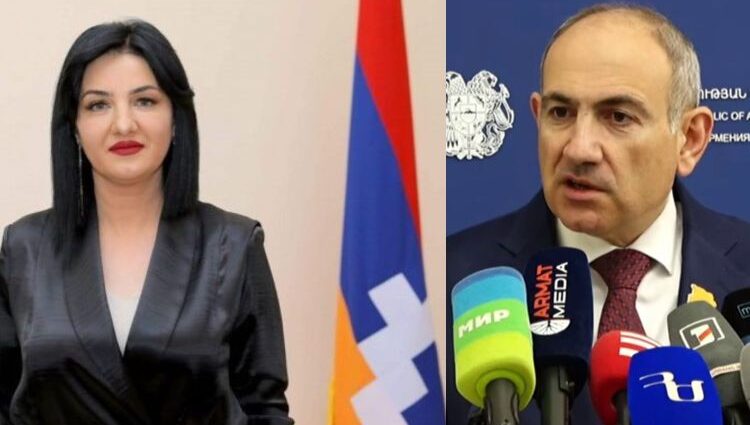
After today’s government meeting, answering journalists’ questions, Nikol Pashinyan openly stated that from now on, structures bearing the name of the Republic of Artsakh and individuals who even hint at the Artakakh issue will be unconditionally punished or subjected to repression. His words aren’t quite so literal, but the context of his statements implies exactly that. How else can one interpret his arrogant admission that he forced the director of the Armenian Genocide Museum-Institute to resign for daring to present a book on the Artakakh issue to US Vice President J.D. Vance, who was visiting Armenia, and to speak about the Sumgait massacre?
In his assessment, this is an act against the government’s foreign policy, a provocation that Azerbaijan could interpret as a call to war. And the government’s foreign policy on this issue is that the Karabakh issue no longer exists. Or his criticism of the mention of the Republic of Artsakh during services in the Armenian Apostolic Church, which Pashinyan also considers a call to war. It sounds absurd, doesn’t it, especially considering that Pashinyan has made no secret of the fact that the issue of the return of the people of Artsakh to their homeland is also closed to him and his government, which, incidentally, is enshrined in international law and remains a pressing issue in many international forums.
Pashinyan threatens that if we continue to discuss the issue of return, Azerbaijan will also raise it, “they will develop, clash, and escalate into war.” And it doesn’t matter that these are by no means equivalent demands: he speaks of the return of the people of Artsakh to their homeland, to their cradle, while Azerbaijan raises the issue of the return of homes once allocated to their ancestors in the sovereign territories of Armenia, claiming that these are ancient Azerbaijani territories.
The Artsakh government, which has found refuge in Armenia, along with government officials and the Artsakh Human Rights Defender, are making efforts to ensure that the return of Artsakh residents remains a topic of discussion in competent international structures so that they can ultimately defend their rights with certain guarantees. However, the Armenian government claims that such a topic is not and cannot be on the agenda, as the Karabakh problem no longer exists. Just as the OSCE Minsk Group dismissed the head of the Armenian government and effectively closed the Artsakh issue, it can similarly hinder all efforts by dedicated Artsakh residents to resolve the issue of return, thwarting all their efforts and hopes. Metaxe Hakobyan, Secretary of the Justice faction of the Artsakh Republic National Assembly, cited Pashinyan’s statements, saying that the authorities are also seriously working in the lead-up to the elections to discredit the residents of Artsakh and devalue the idea of return. “Recently, government cronies have reappeared, wanting to show our compatriots in Armenia that the people of Artsakh are not interested in a homeland, but only in money and satiety. These cronies have become more active and are trying to devalue the actions of those who are at least trying to maintain the urgency of the Artsakh issue in international structures and on various platforms. In this situation, we cannot resolve any issue as long as these authorities exist. But as a result of various meetings with equally important individuals and figures, we can conclude that the Artsakh issue cannot be closed. It will only be resolved when justice is restored on both sides, for both Armenians and Azerbaijanis.” Perhaps now, thanks to the efforts of the Armenian and Azerbaijani leaderships, the Azerbaijanis have developed a sense of justice, while the Armenian people lack such a sense. Specifically, 150,000 Armenians have been forcibly displaced, have become nomads, and are simply eking out a living, waiting for their issue to be resolved at the highest level so they can return home.”
Aren’t they afraid that any mention of the Republic of Artsakh will also make them targets of Pashinyan’s aggression? Metaxe Hakobyan stated that they are consciously prepared for this: “They can subject us to repression, arrest us, they can kill us. I’m not shy about saying this either; what we’ve been through has made us even more determined. The issue of return must always be urgent. Why do these authorities become hysterical at the mention of the word ‘return’? Because they know full well that the right of return of the people of Artsakh will be realized, and it cannot be blocked either today or in the future. Imagine the situation of a parent whose child is buried in Artsakh. It’s impossible to convince them not to visit their son’s grave again. These authorities want to tear them apart, and we will not back down from our goal.”