



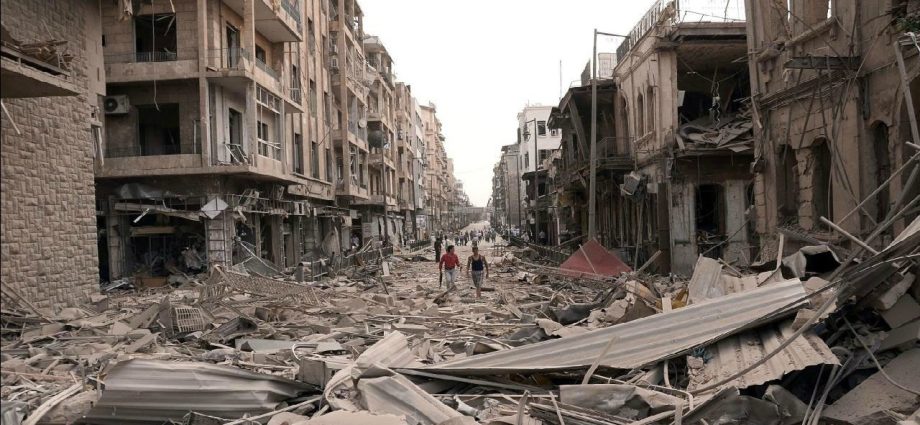
The ceasefire on November 27 was violated, and anti-government Islamist forces quickly captured Aleppo in two or three days and advanced south. The main battles are currently taking place in the area of the city of Hama and the district of the same name. This was stated at a press conference on December 5 by the head of the repatriates’ integration department of the Office of the High Commissioner for Diaspora Affairs, Hovhannes Aleksanyan.
According to him, the situation for the Armenians of Aleppo has changed dramatically, since the attack was unexpected. “In the first two days, Armenian families were able to leave the city not along the main highway, but along secondary roads. We are in touch with these families.
In the first days, the situation around Kessab was also difficult, and even the relevant structures called on its residents to be ready to leave the city. But after a day or two, government forces received reinforcements and now Kessab is not in danger,” Aleksanyan said.
Regarding the situation in Aleppo, he said: “According to our information, there are currently about 10-12 thousand Armenians in Aleppo, they are mainly concentrated in three districts.
At the moment, the city is, so to speak, quite calm. One of the reasons for the success of the advancing forces is that they had many supporters both in the Syrian army and in the city of Aleppo itself, and this contributed to their rapid advance.”
Aleksanyan noted that this time the Islamists are much more moderate in their relations with the city’s public and this may be a new tactic on their part. “Nevertheless, Armenian society is restless, it is worried, many were not ready to leave the city. It is currently very difficult to organize an evacuation. The main actions are developing in the Idlib region, and it seems that the government army has currently focused on suppressing the Idlib center, after which the road to Aleppo will be opened.
I must note that we are in contact with both community institutions and the embassy; a hotline has been published on the embassy and MFA websites, through which our compatriots can contact the embassy,” he concluded.