



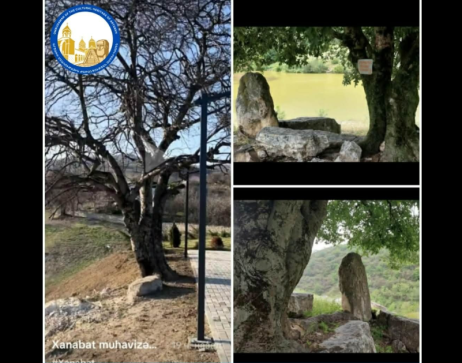
On March 11, 2026, TikTok user xanabat muhavizə (https://vm.tiktok.com/ZS9dtHDAg2SVA-FNuz1/) published another video from the village of Khnapat in the Askeran region of the Republic of Artsakh, temporarily occupied by Azerbaijan. This was reported by Artsakh Cultural Heritage Ombudsman and Vice President of the Azgayin Historical and Cultural NGO, Khovik Avanesov.
“The video clearly shows that a 12th-century khachkar, located under a fir tree in the village, was destroyed under the pretext of ‘construction work.’
“This fact is further evidence of Azerbaijan’s systematic policy of consistently destroying the Armenian cultural heritage of Artsakh. Even more alarming is the fact that the Azerbaijani state propaganda machine is attempting to present Artsakh monuments from the same period as the legacy of “Aghvan,” on the one hand, while at the same time deliberately destroying these same monuments. This contradictory, yet clearly targeted, policy demonstrates that “attribution” and the physical destruction of historical heritage are carried out in parallel, systematically, at the state level.
It should also be noted that not only propaganda structures but also the Azerbaijani armed forces and other security agencies are involved in this process, making the destruction of cultural heritage part of state policy. Dozens of such cases have been recorded both in Artsakh and Nakhchivan, where the systematic destruction of Armenian monuments has been carried out in previous decades.
On February 2, 2026, the Geghard Scientific and Analytical Foundation sounded the alarm about the Church of the Holy Virgin Mary in the village of Vagukhas, Martakert region, becoming the target of Azerbaijani vandalism. According to published information, Azerbaijanis destroyed at least one of the khachkars (cross-stones) installed in the church yard and tore down church icons (https://geghard-saf.am/hy/777/vaghuhas-church-vandalized).
It is important to emphasize that the cultural treasures located in Artsakh are not only Armenian but also have universal significance. Their destruction is aimed not only at falsifying history but also at erasing all cultural memory.
At the same time, it is becoming clear that the Turkish-Azerbaijani tandem’s method of destroying and appropriating Armenian cultural heritage is not limited to Artsakh or Nakhchivan. A similar methodology is also used in various regions of the Middle East, where policies toward historical and religious monuments resemble a pattern. This demonstrates that Turkey and Azerbaijan are not only acting as states committing cultural crimes—genocide—but also exporting the methodology of this policy.
In this context, it is important to emphasize that such actions cannot be viewed solely as the domestic cultural policies of individual states. They are linked to international legal norms and obligations regarding the protection of world cultural heritage, which are binding on all states. Therefore, the deliberate destruction of historical and cultural property, particularly Armenian khachkars, goes beyond regional conflicts and falls under international law and the protection of world cultural heritage.
The destruction of khachkars is prohibited by international law and is considered a grave crime against humanity, as “The Art of Armenian Khachkars: Symbolism and Craftsmanship of Khachkars” is included in the UNESCO List of Intangible Cultural Heritage of Humanity adopted in 2003 and has been considered a universal value since 2010. This means that khachkar art has exceptional universal value and additional international protection.
Khachkar culture also enjoys additional protection during and after war, in particular, in accordance with the principles of the Second Protocol. In addition to the 1954 Hague Convention for the Protection of Cultural Property in the Event of Armed Conflict, adopted in 1999, all khachkarn culture enjoys enhanced protection, and any damage caused to it, according to Article 15(a) of the Protocol, constitutes a “grave breach” that can be qualified as a war crime in international courts. This is evidenced by Article 10 of the aforementioned Protocol on Enhanced Protection of Cultural Property, according to which cultural heritage of paramount importance to humanity must be subject to enhanced protection, and UNESCO has effectively considered the entire khachkarn culture to be such since 2010. According to Article 12 of the Protocol, in the occupied territories, a State Party to the Protocol, namely Azerbaijan, must ensure the inviolability of cultural property under enhanced protection by refraining from its destruction.
“from becoming an object of destruction or repression (https://monumentwatch.org/…/%d5%b7%d5%b8%d6%82%d5%b7…/ ).
Such numerous facts indicate that the actions of the
“The actions of the Azerbaijani authorities can be seen as a manifestation of one of the largest cultural genocides of the 21st century, aimed at destroying historical and material evidence of the Armenian presence in the region,” he wrote.