



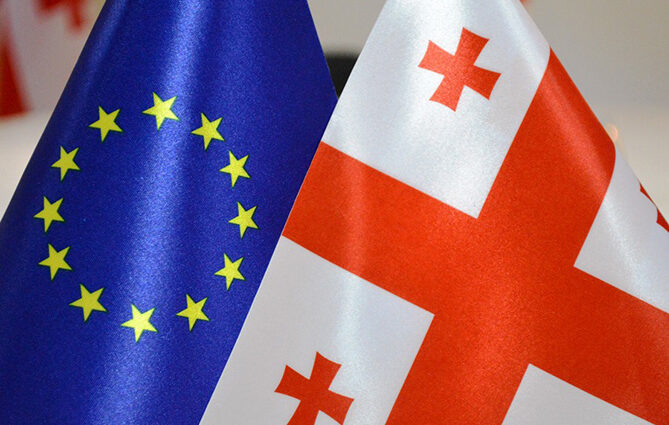
The next meeting of the EU-Georgia Human Rights Dialogue has been postponed indefinitely. It was scheduled to take place in Brussels on November 21.
European Commission spokesperson Anita Hipper said on Tuesday that the meeting was postponed “due to obstacles created by the Georgian side,” according to the Novosti-Gruzia news agency.
She also confirmed her “readiness to hold a meeting on this issue and present the EU’s position on human rights.” According to Georgian media, the meeting was postponed after the Georgian government included a sanctioned official in the delegation.
In response, the Georgian Foreign Ministry accused Brussels of speculation. Tbilisi believes the EU postponed the meeting “under completely unacceptable and unfounded pretexts.”
The ministry emphasized that it had meticulously prepared for the meeting and viewed it as “an opportunity to engage with the European Union, including on issues on which our society often hears criticism from Brussels.” According to a statement from the Ministry of Foreign Affairs, the delegation was formed “with these needs in mind.”
“Using the aforementioned issue for further speculation raises legitimate doubts and creates the impression that the EU External Action Service was not motivated by a sincere desire to hold the meeting, and that Brussels is not prepared to listen to the substantiated positions of the Georgian side, including on issues that were used to suspend political dialogue with Georgia,” the statement read.
The ministry emphasized its commitment to a constructive approach and the absence of alternatives to dialogue, noting that Georgia’s participation in various negotiation formats with the EU is possible only after “the full resumption of the dialogue suspended by Brussels.”
Human rights dialogues are one of the key instruments of EU foreign policy in the area of human rights. They involve representatives of the EU External Action Service, partner country governments, and civil society. The most recent, 16th meeting, took place in Tbilisi in 2023, and the 2024 round was postponed.
Relations between Georgian Dream and Brussels deteriorated in the spring of 2024 following the adoption of the Foreign Agents Law. The EU suspended Georgia’s membership application, froze some financial aid, and cut off high-level contacts with the government. The European Parliament did not recognize the results of the disputed 2024 parliamentary elections, won by the ruling party. On the same day, Prime Minister Irakli Kobakhidze announced that Georgia was removing EU membership negotiations from the agenda until 2028. This decision sparked mass protests across the country.
The EU Enlargement Report 2025 states that Georgia has “seriously regressed” in virtually every area and remains a candidate for EU accession only “nominal.” The report criticizes the adoption of anti-democratic laws targeting NGOs, media, and LGBT individuals, restrictions on freedom of assembly and expression, and the presence of “political prisoners.” The European Commission emphasized that the authorities’ actions are contrary to EU values and the expectations of a candidate country.
Following the publication of the report, Georgia was not invited to the annual EU Enlargement Forum, which took place on November 18.