



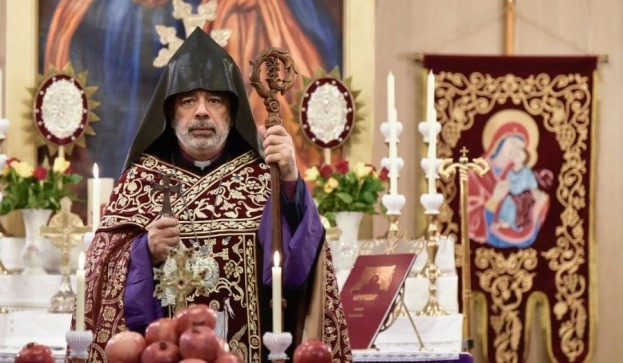
The Primate of the Armenian Diocese of Germany, His Grace Bishop Serovbe Isakhanyan, commented on the situation surrounding the Armenian Apostolic Holy Church.
His Grace Serovbe stated that the Armenian Apostolic Church, as the guardian of spiritual and national values, is by its very nature a non-partisan structure.
Its mission is above partisan interests, political struggle, and the pursuit of power. The Church’s goal is the development of spiritual, moral, and national life, not the pursuit of political influence or participation in government.
The Church in Electoral Processes
During elections and political struggles, the Church is obligated to maintain partisan neutrality. It cannot and should not publicly support any party or candidate. This stems not only from the need to maintain the Church’s reputation, but also from its mission to serve all believers, regardless of their political views.
This principle also applies to every clergyman. Although a clergyman (or most of them) is a citizen of the Republic of Armenia and has all the rights and obligations of citizenship, their mission requires them to refrain from political statements and partisan leanings, whether pro- or anti-party. A clergyman’s word carries great influence in society, and therefore it should not become an instrument of partisan interests. In the voting booth or at the ballot box, a clergyman… Naturally, a person is free to cast their vote for the political party of their choice and, with this united vote, contribute to the victory of the political force they favor.
The Difference Between National and Partisan Issues
It is important to clearly distinguish between national and partisan issues. The Church cannot remain indifferent to issues related to the protection of national identity, social justice, human rights, personal dignity, and moral values. In these areas, the Church has the right and obligation to express its position, whether approving or critical.
Such a position by the Church cannot be viewed as political interference. The Church’s natural duty is to openly speak out against violations of public morality and to defend humanity as the image and likeness of God.
Relationships between the Government and the Church
The state and government bodies are obligated to respect the opinion of the Church, perceiving it not as political opposition, but as a moral guide. The Church’s viewpoint should be viewed as social and moral advice that can contribute to the improvement of legislation and the strengthening of the moral foundation of government decisions. Responsible government bodies, naturally, may also reject the Church’s approaches. The Church, in turn, can continue its critical discourse, raise issues for public debate, and exert public pressure through legal means, facilitating the revision and reform of laws.
It is a sign of a healthy society and true democracy when the state and church act in an atmosphere of mutual respect, cooperation, and responsibility.
The Difference Between Criticism and Insult
Freedom of criticism is one of the important values of a democratic society. However, criticism must be constructive – free from insults, curses, slander, and gossip.
The Church must foster a healthy critical culture by example, demonstrating that criticism and slander are two different categories. Criticism stems and should stem from positive interest and is aimed at reform and enrichment, while insult only destroys social unity.
Relations between Church and State must be based on mutual respect, a clear division of responsibilities, and cooperation for the public good.
The Church is called to maintain the spiritual balance of the people, guided by the principles of love, justice, and truth. The State, in turn, is obligated to respect this mission of the Church and protect its right to hold and express its Christian and humanistic point of view.
“Only with such mutual understanding is it possible to build a society in which the church and the state, each in its own sphere, serve the same goal: the preservation of human dignity, justice, and national unity,” wrote Bishop Serovbe Isakhanyan.