



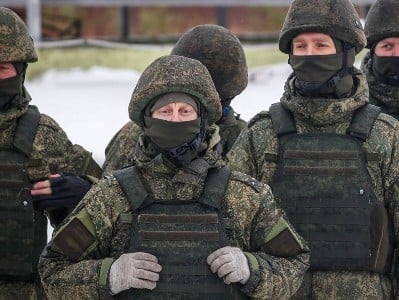
While many countries are focused on events around Ukraine, Vladimir Putin is quietly preparing for a conflict with NATO by increasing his military presence near the borders of Finland and the Baltics. According to Western intelligence and military officials, the Leningrad Military District, recreated in early 2024, is intended to become a base for confrontation with the North Atlantic Alliance. The Kremlin is building military installations there, modernizing railway lines in border areas, and also expanding recruitment and increasing weapons production.
The authorities plan to create a new army headquarters in Petrozavodsk within a few years to manage tens of thousands of troops who will be stationed at the currently expanding military bases, The Wall Street Journal writes. According to Western military and intelligence officials, many of them are planned to be redeployed there after the full-scale war in Ukraine ends, with small brigades almost tripling in size to 10,000-strong divisions. “No matter how much they try to innovate at the tactical or operational level, for the Russians, size is paramount,” said Maj. Gen. Sami Nurmi, the Finnish deputy chief of staff responsible for strategy. “It always comes down to numbers.”
“The logic of the last decade shows that we expect some kind of conflict with NATO,” says Ruslan Pukhov, director of the Center for Analysis of Strategies and Technologies in Moscow. The increased military presence near the Finnish border is part of the Kremlin’s preparations for such a conflict, and “when the troops come back [from Ukraine], they will be looking across the border at a country they consider an adversary,” he explains.
Donald Trump dismisses fears that Russia could escalate beyond Ukraine as exaggerated. Asked in February about Volodymyr Zelensky’s warning that Russia could start a war with NATO if the US cuts support for the alliance, Trump said: “I don’t agree with that, not one bit.”
In turn, the countries on NATO’s eastern flank disagree with him. Finland, Latvia, Estonia, Lithuania, and Poland are strengthening and mining (or preparing to do so) the border, building fences, anti-tank obstacles, and fortified points. In 2021, Russia produced about 40 T-90M main battle tanks, but now their annual production has increased to 300; a high-ranking Finnish military official believes that the fact that they are almost never sent to the Ukrainian front, but are being held back for future use, is one of the signs that Putin is preparing for a larger confrontation.
Russian rearmament plans are being adjusted to take into account the needs of new troops that will be deployed along the border with NATO. It is mainly old and repaired Soviet equipment that is sent to the war in Ukraine, while newly produced equipment is primarily intended for new units. Recently, the Ukrainian military has very rarely observed or destroyed new Russian equipment, says Dara Massicot, a senior fellow at the Carnegie Berlin Center for Russia and Eurasia.
According to satellite images from 2022 and 2025 analyzed by the Finnish OSINT organization Black Bird Group, new barracks have appeared at the military base in the village of Kamenka in the Vyborgsky district of the Leningrad region near the Finnish border. And at the Northern Fleet base Sputnik, a few kilometers from the border with Norway and Finland, there are new warehouses for military equipment. In October 2024, Defense Minister Andrei Belousov visited Sputnik together with the commanders-in-chief of the Russian Navy and the Northern Fleet, the specialized publication Barents Observer reported. According to the plans of the Russian Armed Forces, several warehouses for weapons and military equipment, including missiles and artillery, new barracks and dormitories should be built there by 2030, which was reported to Belousov.
The 61st Marine Brigade stationed in Sputnik is actively involved in the war against Ukraine. According to a report by Norwegian intelligence in early 2023, in less than a year of fighting, it lost about 80% of its personnel, the Barents Observer notes.
New railway lines are being laid along the borders with Finland and Norway, as well as south of St. Petersburg to the border with Estonia. Existing lines in the region are also being expanded.
Danish intelligence warned in February 2025 that Russia could start a large-scale war in Europe within five years. A ceasefire in Ukraine will allow it to prepare even faster, the WSJ writes, citing Western military officials. “We don’t have much time,” Polish Defense Minister Wladyslaw Kosiniak-Kamysz told the newspaper. “We have to create a strong alliance, a strong command structure and well-equipped armed forces.”