



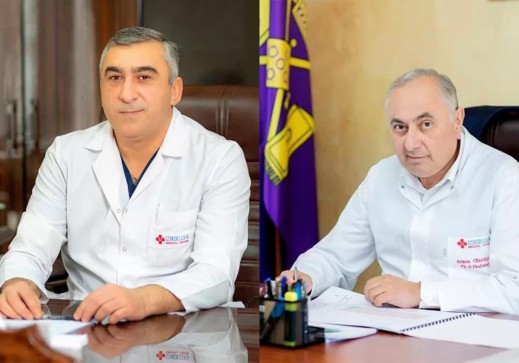
Lawyer Erik Aleksanyan wrote:
“Several days ago, illegal court decisions led to searches of the offices of Professor Armen Charchyan, Director of the Izmirlyan Medical Center, and Tigran Nalbandyan, Deputy Director for Medical Affairs. These decisions were appealed in the Court of Appeals.”
The court failed to consider the following two important circumstances when reaching its decision:
1. Although Armen Charchyan is formally and legally the director of the Izmirlyan Medical Center, and Tigran Nalbandyan is the deputy director, the latter are, in essence, physicians by profession. In their offices, in addition to administrative functions, they also perform activities related to medicine itself, namely, receiving patients, consultations, visual examinations, reviewing medical records, prescribing treatment, and other professional functions equivalent to those of the rest of the medical staff working at the Izmirlyan Medical Center.
The court did not address this circumstance in its decisions. In its decisions, the court did not explain why accounting, payment, and settlement documents or other materials should be kept in the offices of Armen Charchyan, as the formal legal director of the Izmirlyan Medical Center, and Tigran Nalbandyan, as the formal legal director of the Izmirlyan Medical Center, and also a physician in a material sense. This again refers to the nature of the aforementioned documents, given that, as has already become clear, Armen Charchyan and Tigran Nalbandyan are de jure the director and deputy director of the Izmirlyan Medical Center, but the latter is a physician in a material, functional sense.
2. The search of the offices of Izmirlyan Medical Center Director Armen Charchyan and Deputy Director Tigran Nalbandyan also violated the principle of inadmissibility of publishing information containing medical secrets, as the petitions for search permission concerned searches of the offices of medical professionals, and the lower court, in fact, failed to specify whether there were restrictions on searching the doctors’ offices. The doctors’ offices were robbed.
Although the court of first instance emphasized in its decision the limits of objects that the investigating authority may discover and seize as a result of a search, the court of first instance, even under these circumstances, did not take into account that the search would be conducted not only in the offices of persons holding the positions of director and deputy director of the Izmirlyan Medical Center, but also in the offices of persons primarily assigned professional duties and responsibilities, where, within the presumption of reasonableness, even at the level of assumption beyond any reasonable doubt, there is a high probability of containing information about the health status of patients or the receipt of medical care and services, which undoubtedly constitutes a medical secret within the meaning of Part 1, Clause 14 of the RA Law “On Medical Care and Services to the Population.”
Moreover, in the context of criminal procedure law, information constituting a medical secret is information obtained and used exclusively with the permission of a court. Therefore, based on the logic of the law, the inadmissibility of disclosing information constituting a medical secret allows us to confidently assert that, even without the possibility of using it, the very act of providing such information to the body conducting the proceedings grossly violates the generally accepted and constitutional rights to privacy and immunity of numerous patients.
In other words, in the presence of information about a proposed criminal case that may concern one or more individuals, the fundamental rights of numerous patients are restricted, which clearly upsets the balance between public and private interests and does not follow from the interests of the administration of justice in the broad sense. To summarize, it is worth noting that during the search of the offices of doctors Armen Charchyan and Tigran Nalbandyan, work computers containing information constituting a medical secret for numerous individuals were also seized.
Although it’s clear that this information is of no interest to the investigation and cannot be used in criminal proceedings, it’s undeniable that before the investigator decides whether to use it in the proceedings, they must conduct a meaningful investigation that will allow them to obtain medical secrets. This jeopardized the principle of inadmissibility of obtaining medical secrets. In other words, the court didn’t even provide a way to separate data containing medical secrets from data important to the case, and by granting permission, it effectively jeopardized the principle of inadmissibility of publishing medical secrets.
(Facebook share button, Messenger share button)