



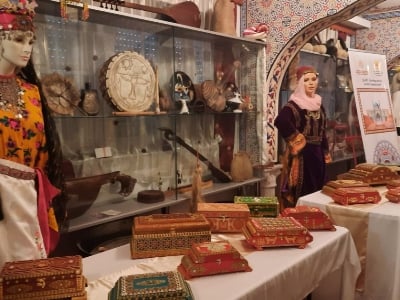
The website monumentwatch.org, which monitors the cultural heritage of Artsakh, mentioned the “Western Azerbaijan Crafts” project presented in Nuremberg.
“On September 24, 2025, Azerbaijani media reported on the completion of the “Western Azerbaijan Crafts” project, which was implemented by the public association “Support for the Preservation and Dissemination of Applied Arts” at the Museum of Turkish History and Culture in Nuremberg, Germany. The project’s goal was to introduce Europeans to the “rich cultural heritage of Azerbaijan.”
One of the main organizers of this series of events held in Germany, Cemaleddin Özdemir, founder of the Museum of Turkish History and Culture, noted in his speech that such projects could greatly contribute to the further deepening and development of cultural ties between Germany and Azerbaijan. Over the course of five days, various events took place in Nuremberg: at the Objective Cultural Center, the Turkish Theater, and the Medina Association.
These venues hosted exhibitions, discussions, and art evenings; an Azerbaijani-Turkish musical evening was also held as part of the events organized at the Turkish Theater.
Such events reflect Azerbaijani policy attempts to rewrite the region’s historical memory in international forums, associating it exclusively with Azerbaijani or Turkish identity.
The very formulation of the project’s name is political. The term “Western Azerbaijan” is used in official Baku discourse to refer to Armenian territory, viewing it as “historical Azerbaijani land.” Thus, this project is not limited to the dissemination of art: it incorporates the ideological element of territorial claims through which the Azerbaijani authorities are attempting to shape a new cultural narrative. Hosting the project in Germany, before a European audience, is intended to reinforce this narrative at the foreign policy level.
Here, culture is used as “soft power”: through projects implemented at international venues, Azerbaijan attempts to convince the international community of the naturalness and legitimacy of the historical narrative it presents.
It is noteworthy that in such initiatives, the Azerbaijani side invites a person it presents as the heir to the last khan of Yerevan. This person, Amir Ali Sardari Irevan, is, according to the Azerbaijani side, a symbolic figure, recalling the continuity of Azerbaijan’s historical territories and cultural heritage. His participation in the event further emphasizes the idea that applied art is not only a form of artistic expression but also a means of preserving national memory and identity.
The project was funded by the Agency for State Support to Non-Governmental Organizations of Azerbaijan. This initiative can be seen as a tool of Azerbaijan’s cultural diplomacy, using culture as “soft power.”
Thus, the “Western Azerbaijani Crafts” project held in Nuremberg is not just a cultural initiative, but a continuation of Azerbaijan’s cultural policy aimed at rewriting historical memory and rejecting Armenian cultural heritage.