



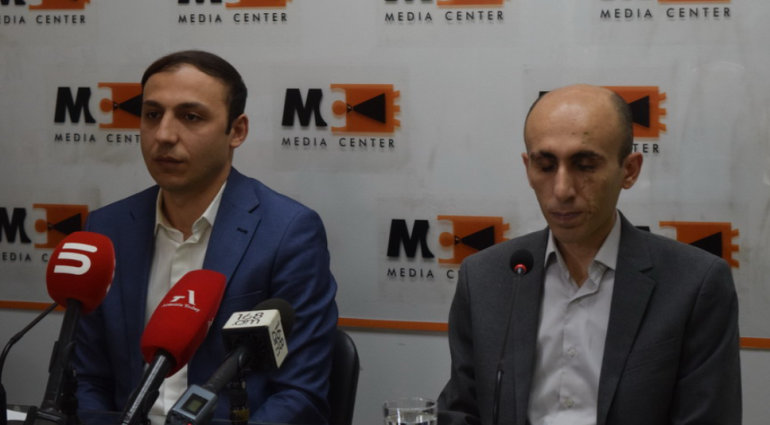
During the US Vice President’s visit, numerous letters and petitions were sent to him regarding the release of the Armenian hostages illegally held in Baku. Artsakh Ombudsman Gegham Stepanyan wrote about this.
“In our letter, prepared jointly with Artak Beglaryan, we draw the US Vice President’s attention not only to the issue of the hostages, but also to the fate of the missing, which is a key issue of concern to our society and the families of the missing.
I am enclosing a letter sent to Vice President Vance’s office as part of the official White House procedure.
Letter to US Vice President J.D. Vance
From Gegham Stepanyan and Artak Beglaryan, Nagorno-Karabakh (Artsakh) human rights defenders
Dear Mr. Vice President,
We welcome your diplomatic mission to our region. This visit comes at a crucial moment in the peace process endorsed by President Trump. As Artsakh (Nagorno-Karabakh) human rights defenders, we emphasize that the success of the Trump Path to International Peace and Prosperity (TRIPP) and the outcome of the Washington Summit in August 2025 depend greatly on overcoming the wound’s profound humanitarian problems.
While political agreements are being signed, hundreds of Armenian families whose relatives went missing during the Azerbaijani aggression of 2023, 2020, and 1990 remain in a painful limbo. Baku’s continued lack of cooperation on the issue of missing persons is not a minor issue. This is a major source of regional tension and a grave violation of the fundamental human right to know the fate of one’s loved ones.
A lasting peace cannot be built on the foundation of an “unknown fate.” We ask the US Administration to take a leading role in the following areas:
• Establishing a neutral, fact-based mechanism to search for and identify persons missing as a result of the explosion at the fuel depot in Nagorno-Karabakh.
• Ensuring full transparency and cooperation from Azerbaijan in the search and repatriation of persons or their remains.
• A clear commitment that clarification of the fate of the missing will be considered a prerequisite for the full implementation of regional projects.
The need for clarity on the issue of missing persons is compounded by the urgent issue of the 19 Armenians still imprisoned in Baku. Their continued imprisonment, accompanied by sham trials and life sentences handed down just this month, is a clear humanitarian obstacle that must be overcome.
Securing the freedom of these individuals is the simplest and most effective step the United States can take to demonstrate that this peace process is based on justice, not mere compromise. It is the most direct and shortest path to building public trust and confidence among the Armenian people in the peace agenda. Without these fundamental humanitarian steps, regional infrastructure projects will lack the social foundation necessary for long-term stability.
President Trump has repeatedly stated that true stability is built on strength and clear moral commitment, especially when it comes to protecting vulnerable populations and religious heritage. Your presence in the South Caucasus is a powerful signal that the United States intends to lead this mediation toward a final, just, and dignified peace.
“We urge you to make the resolution of the missing persons issue and the release of all Armenian prisoners of war key topics of your discussions in Baku,” Stepanyan wrote.