



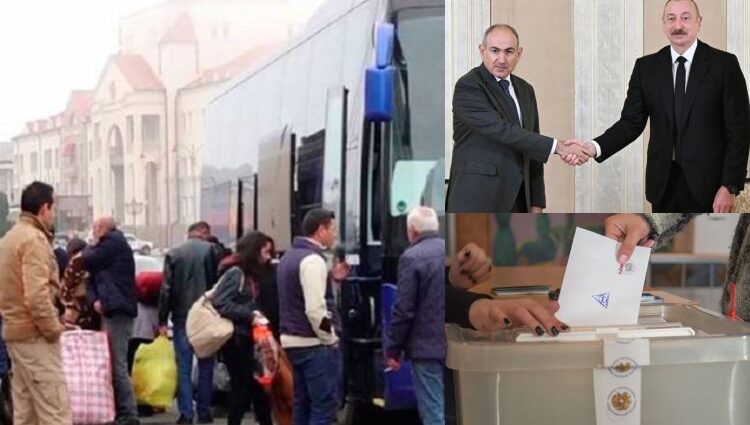
Both the government, the opposition, and a conscious part of the public view the upcoming parliamentary elections not as a political process, but as a struggle for existence: the government for its life and freedom, the opposition and public for the preservation of the state’s existence and identity.
It is therefore unsurprising that the authorities, possessing significant levers of power and resources, will do everything possible to reproduce themselves, driven by fear for their own survival. In this context, alarming calls are already being heard from residents of Artsakh who were forcibly displaced from their homeland and have found refuge in Armenia. According to them, state agencies are currently not reviewing their applications for Armenian citizenship and are delaying them under various pretexts until June 7. They believe they are being deliberately kept waiting so they cannot participate in the upcoming parliamentary elections, as only adult citizens of the Republic of Armenia have the right to vote.
Metaxe Hakobyan, co-founder of the NGO “Justice and Return,” reported that citizenship applications have been sent electronically since this year, but invitations to collect documents are delayed, unlike before. The expedited procedure for obtaining Armenian citizenship on the website of the Migration and Citizenship Service states that applications for Armenian citizenship are reviewed within ninety working days from the date of submission to the authorized government body. Metaxe Hakobyan says this three-month period has now been extended to six months.
Initially, citizenship was granted to residents of Artsakh within one to two months. This was the case until the end of last year, after which applications were submitted online, and the process became more complicated and unmanageable. According to him, 99 percent of Artsakh residents who have found refuge in Armenia feel hostility toward the current Armenian authorities, and the authorities provide them with no support. He reached this conclusion based on the results of a survey conducted by the NGO “Justice and Return” among 1,500 residents of Artsakh. According to these surveys, only 1 percent of Artsakh residents in Armenia moderately support the Pashinyan government. A significant portion of these are typically displaced persons, while native residents of Artsakh are willing to cast their votes for genuine opposition forces if they have the opportunity to participate in the elections. He believes that this circumstance may be the reason for the delays in granting Armenian citizenship to residents of Artsakh. Thus, the authorities may be annulling potential opposition votes by preventing internally displaced persons from participating in the elections.
We tried to clarify the reason for the delays in processing citizenship applications with Nelly Davtyan, head of the Migration and Citizenship Service. According to him, the number of applications from Artsakh residents has increased, which is why the delays are occurring, as the presidential administration does not have time to respond to everyone, and new applications are constantly being received in response to those already processed.
“At any given time, we have approximately 1,000 files in the presidential office. Work doesn’t stop; it continues. We simply update these files with new applications after each response. Currently, the citizenship process takes four and a half months, as stipulated by the expedited procedure for obtaining citizenship. Before the launch of the electronic platform, we processed cases fairly quickly, although the process remained the same. However, with the launch of the electronic platform, the number of applications has increased, likely also due to the fact that it became possible to submit applications from home and without waiting in lines. Our annual application intake record was 21,000, and in the last three months of this year alone, 12,000 applications were submitted. We are currently working intensively, also processing applications received in paper form last year. We do not violate the law or exceed the statutory deadlines, but since our compatriots expect to receive a response within one or two months, as before, they complain about delays. We have concentrated all our resources and attracted additional resources.” “To minimize the workload and return to the previous accelerated work schedule,” the head of the service said in an interview with us.
According to him, starting this year, the citizenship application process has been transferred to a digital format. Until December 30, 2025, these applications were accepted in paper form. Before digitalization, 26,777 applications were submitted by residents of Artsakh. From January 1 to the present, 6,965 applications have been submitted through the digital platform, meaning 33,742 applicants are awaiting a response, most of whom have not received a response within 3-4 months. Currently, 23,526 residents of Artsakh have been granted citizenship of the Republic of Armenia by presidential decree. About 12,000 minors also received passports with a Republic of Armenia citizen’s passport without consent.
Parental consent is based on the principle of imum. As a result, 35,526 forcibly displaced residents of Artsakh are already citizens of the Republic of Armenia.
We also asked Nelly Davtyan how many forcibly displaced persons are in Armenia as refugees. According to the service, the initial number was 112,000, but the number of subjects in the state population registry of Artsakh is 150,000. It is possible that some of them never returned after the war, and some were abroad, so they were not included in the list of displaced persons in 2023 as such. Accordingly, more than 90,000 residents of Artsakh are still here as refugees and, for various reasons, do not yet plan to become citizens of the Republic of Armenia.