



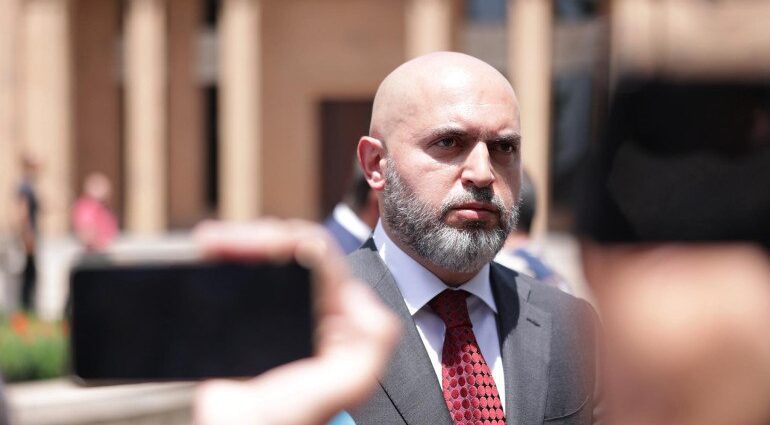
I know that Pashinyan is most nervous about the Artsakh issue. RPA Deputy Chairman Armen Ashotyan wrote about this.
Therefore, I want to remind him once again, with facts, of the negotiating legacy he squandered, bringing disaster upon our country and people.
The negotiating legacy we left behind, the provisions we had in terms of clarifying the mechanisms for international recognition, guaranteeing and implementing the rights of the people of Artsakh, enshrined at the level of the OSCE Minsk Group Co-Chair countries, has long been known and has been detailed by Serzh Sargsyan, Eduard Nalbandian, our fellow party members, independent experts, and other political figures.
Therefore, without the ability to confirm the legacy of our negotiations with internal sources, I will only cite international or regional sources that corroborate my statements.
The five joint statements of the heads of state of the OSCE Minsk Group Co-Chair countries from 2009 to 2013, in which the right of the people of Artsakh to self-determination was enshrined in the Basic Principles of the settlement, and the most important components of realizing the right of the people of Artsakh to self-determination were specified in the elements of the settlement. For example, the L’Aquila Statement of 2009 stated, in particular:
The final status of Nagorno-Karabakh (NKR) must be determined by the expression of the will of the people of the NKR, the results of which will have international legal force;
Until the final status is determined, the NKR will have a temporary status recognized by the international community;
Land communication between Armenia and Nagorno-Karabakh must be ensured.
These principles and elements were subsequently further detailed, expanded upon, and implemented, as you will see from other facts presented below.
(Link: https://www.osce.org/mg/51152)
The Russian Foreign Ministry’s official response to Nikol Pashinyan’s article “The Origins of the 44-Day War” from January 13 of this year, which clearly outlines the negotiating legacy left by Serzh Sargsyan, states, in particular: “Regarding the options for resolving the issue of Nagorno-Karabakh’s final status, the proposals put on the negotiating table in recent years were viewed as the ultimate goal, and I quote: ‘Determining the final arbitral status of Nagorno-Karabakh under the auspices of the UN or the OSCE within a timeframe agreed upon by the parties through a nationwide vote, which will express the free will of the people of Nagorno-Karabakh and will be legally binding, in accordance with the norms and principles of international law.'” Incidentally, it was also proposed to consider the width and status of the Lachin corridor only at the second stage.” This same clarification also contains the following very important assessment, testifying to Pashinyan’s squandering of our negotiating legacy: “These approaches persisted until 2018, when Yerevan put forward new approaches.” (Link: https://www.mid.ru/…/cKNonkJE02Bw/content/id/4519475)
Official response of the Russian Ministry of Foreign Affairs to the statements of the Speaker of the National Assembly of December 3 of this year, which once again confirm the pro-Armenian content of the decisions in the negotiating package we left behind.
(Link: https://tass.ru/politika/13105793)
The Comprehensive and Enhanced Partnership Agreement between Armenia and the European Union, signed on 24 November 2017, contains the following provision: “RECOGNIZING the importance of the commitment of the Republic of Armenia to a peaceful and lasting settlement of the Nagorno-Karabakh conflict and the need to achieve this settlement as soon as possible within the framework of the negotiations conducted by the OSCE Minsk Group Co-Chairs; recognizing also the need to achieve this settlement on the basis of the purposes and principles enshrined in the UN Charter and the OSCE Helsinki Final Act, in particular the purposes and principles related to the renunciation of the threat or use of force, the territorial integrity of states, and the equal rights and self-determination of peoples, and reflected in all statements made within the framework of the OSCE Minsk Group Co-Chairs since the 16th meeting of the OSCE Ministerial Council in 2008; Noting also the European Union’s commitment to supporting this settlement process: “This clearly demonstrates that the European Union has formally enshrined in a legally binding document the principle of the right of the people of Nagorno-Karabakh to self-determination and its support for all proposals of the OSCE Minsk Group Co-Chairs (see paragraph 1)
(Link: https://www.mfa.am/filemanager/eu/CEPA_ARM_1.pdf)
The official clarification of the Russian Foreign Ministry spokesperson Maria Zakharova from April 9 of this year explains the mechanisms of international guarantees and the legal consolidation of the package proposed by the co-chair countries: “I would like to emphasize that the package of proposals for the settlement, in addition to