



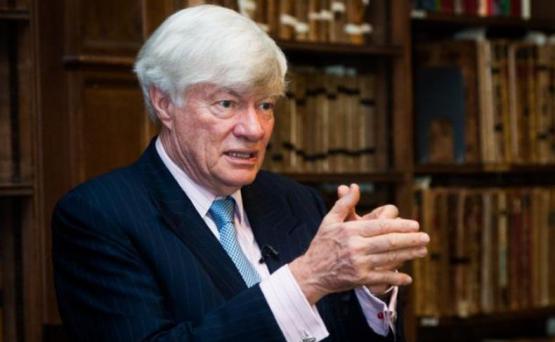
A world-renowned Australian-British lawyer, legal scholar and scholar Geoffrey Robertson (KC) has issued a statement on the illegal criminal prosecution of Samvel Karapetyan.
“It is obvious to any reasonable judge that Samvel Karapetyan did nothing illegal. He simply responded to the Prime Minister’s exaggerated and provocative attacks against him and his church. In his first statement, when he was asked for his opinion on a matter of public interest, he expressed it by noting that an attack on the church is the same as an attack on the people, and that he, as a supporter of the church, will be involved along with others, in their, that is, “our way.” There was no hint in that statement of criminal involvement, violence or any other illegal action; at most, it could have meant defending the church through public support or public stance.
In no democratic country, where freedom of speech is guaranteed by the Constitution (as it is also guaranteed by the Constitution of the Republic of Armenia and duly ratified by international treaties), can it be argued that the opinions expressed by Mr. Karapetyan have such a meaning, interpretation, or consequence. Thus, it is irrelevant from a legal perspective whether the Prime Minister had justifiable grounds for criticizing the church or the defendant. What is important is that Mr. Karapetyan did not call for the violent overthrow of the government, the crime with which he is accused. The state had no legal basis to detain Samvel Karapetyan for a non-existent crime.
Let me be clear and concise: it does not matter whether the Prime Minister had justified reasons to criticize the church and its leader, or even to insult Mr. Samvel Karapetyan. Samvel Karapetyan had the right to reply, which cannot be punished by the law for calling for the seizure of power, if he used that right to reply without inciting violence or rebellion or preaching. The indisputable evidence, the statements made, in their literal and contextual sense, show that he did not do so. This also follows from a number of important and precedent-setting decisions of the ECHR, in which the European Court has established that the limits of permissible criticism are wider towards governments than towards private individuals or even political figures. The European Court has subsequently applied this principle as a fundamental rule of democracy, demanding the repeal or reinterpretation of laws that restrict free speech towards the government or its leaders on matters of political or public interest.
Article 422 of the Criminal Code of the Republic of Armenia, which deals with the seizure of power, requires proof that the public statement contained a call to “seize power” (i.e., incite the use of force) or “overthrow the constitutional order by force.” When the government, by attacking a church, applies this law against a believer who has twice expressed his opposition to the government without publicly advocating violence or the use of force, this is a clear violation of Article 10 of the European Convention on Human Rights and a clear violation of the principle of the rule of law as a vital component of Armenian democracy.
When an abuse of power occurs and the parliament is unable to correct it (because the abuser has the support of political allies), the responsibility to correct that abuse falls on an independent judiciary. Does Armenia have one? Personally, I would like to believe that it does. However, in the case of Mr. Karapetyan, this raises serious doubts. He was held in detention on illegal charges for over 100 days, with bail applications rejected in both the first instance and appellate courts, neither of which addressed the groundlessness of the charges.
It has been argued that “investigative actions are continuing,” which is absurd, since the charges are based entirely on two public statements that Mr. Karapetyan himself has not denied, and which are public. This is the only basis for the charges, so there is no point in continuing the investigation. Similarly, it has been argued that he may have “influenced witnesses,” but there was simply no need for witnesses, since the charges depended solely on the court’s interpretation of the meaning of those two statements, in circumstances that were not subject to challenge.
The conduct of these judges is inconsistent with their duty to be independent defenders of the freedom of speech guaranteed by the Constitution. They should have realized that the consequence of this unnecessary decision to deprive him of his liberty was to deprive him of his freedom of expression for months.