



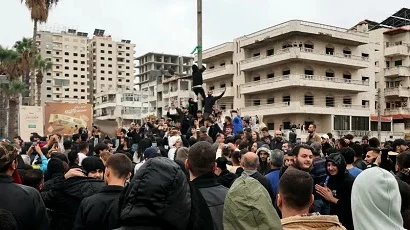
On Sunday, Syrian Alawites took to the streets of the coastal city of Latakia to protest the explosion at a mosque in Homs two days ago, which killed eight people, AFP reports.
The attack in the Alawite neighborhood of Homs was the latest in a series of attacks against the religious minority.
According to an AFP correspondent, security forces were deployed in the area to quell clashes between protesters and counter-protesters.
Sunday’s demonstration followed a call by prominent cleric Ghazal Ghazal. He is the head of the Islamic Council of Alawites in Syria and Abroad, who on Saturday called on people to “show the world that the Alawite community cannot be humiliated or isolated.”
“We don’t want civil war, we want political federalism. We don’t need your terrorism.” “We want to determine our own destiny,” he said in a video message published on Facebook.
Protesters carried photographs of Ghazal and banners in his support, chanting calls for decentralized government power and a degree of regional autonomy.
Since the fall of the Assad regime, the Syrian Observatory for Human Rights and residents of Homs province have reported abductions and killings of members of minorities.
The country has also seen several bloody outbreaks of sectarian violence. In March, mass killings of Alawite civilians occurred in coastal areas of Syria, with authorities accusing armed Assad loyalists of inciting the violence by attacking security forces.
The National Commission of Inquiry reported the deaths of at least 1,426 members of the minority, while the Syrian Observatory for Human Rights estimates more than 1,700. Late last month, thousands of people gathered in coastal areas to protest renewed attacks against Alawites in Homs and elsewhere.
Before and after the March bloodshed, authorities carried out a large-scale arrest campaign in predominantly Alawite areas. On Sunday, protesters also demanded the release of detainees.
On Friday, Syrian state television reported the release of 70 detainees in Latakia “after it was proven they were not involved in war crimes.” The report stated that more releases were expected. Despite Damascus’ assurances of protection for all communities in Syria, the country’s minorities remain fearful for their future under the new authorities, who have so far rejected calls for federalism, AFP reports.