"Yerevan. city and history" international conference. The event was attended by more than 80 speakers from Armenia, Russia, Germany and the United States of America, as well as 30 educational, cultural and state institutions. Participating institutions included Eberhard Karl University of Tübingen, Bremen University of Applied Sciences, Peoples' Friendship University of Russia, and the National Presbytery of the Armenian Eastern Diocese of the USA. According to the director of the museum, Gevorg Orbelyan, this conference was a great opportunity to present new research and expand international ties. The presented reports touched on Yerevan's history, urban planning, architecture, as well as archaeological works and museology. Three participants of the conference shared their impressions and discoveries. Yerevan is the city where I would love to live Russian literary critic, doctor of philology, professor Eleonora Shafranskaya was one of the participants of the conference. He studies Armenia through the prism of literary poetry and memoirs of the 20th-21st centuries, using the example of the works of Mandelstam, Brusov, Yevtushenko, Vasiliy Grossman, Andrey Bitov, Dina Rubina and other authors. It turned out that every year since 2011, I have come to Armenia to participate in various conferences or give lectures at the invitation of the luminary Mikael Amirkhanyan, the president of the "Russia-Armenia" NGO. Even now I come regularly. Let me say that the very first visit was enough for me to love Armenia. Moreover, Yerevan is the city where I would love to live. You are a self-sufficient people, this is your native land, your comfortable city. I am happy that Armenia is in my biography, in my life. At the same time, my visits are not a tourist tour. This is the impression and experience that I share with my students. The scope of my study is the research of the "Armenian text" in Russian literature through a pattern (model). My scientific work "Ararat, the main pattern of the Armenian text in Russian poetry" is dedicated to the key national and cultural symbol of Armenia and its reflection in Russian lyric poetry. I have studied the image of Yerevan and Armenia during the breakthrough eras, for example in Yuri Karabchievsky's Uncensored Armenia, based on his research for Nostalgia for Armenia. The topic of my report at this conference was "Os "The location of Yerevan "discovered" for history by Mr. Mandelstam and Yuri Karabchievsky". By the way, Karabchievsky was an electronics engineer and in 1976 he came to Yerevan on a business trip to repair medical equipment. "This accidental trip," Karabchievsky wrote in his book, "changed my life." In Armenia, I understood for the first time what the motherland is, which you carry inside you. Being Armenian is not a misfortune or a duty for them, it is their essence." The museum not only presents the history of streets, squares and buildings. It is people, the passage of time, an important part of our history. Firdus Zakaryan, former deputy mayor, chief specialist of the Karen Demirchyan Museum The 95th anniversary of the museum is an important event and this event should be publicized and it would be right that the conference was attended by representatives of the city government and the press, mass media were also honored with their presence. Anyway, I must say that it was very well organized. We heard interesting reports. Each report contained special information, a fact, a little "raisin". For example, the first advertisements of Yerevan, or Yerevan sweets of the 1900s as a mirror of city life, the results of new excavations in Silikyan and Kondi districts and many, many other interesting reports. My report at the conference was about how the Museum of History of Yerevan went through a difficult and complicated path moving from one building to another until it appeared in a part of the Yerevan City Hall building. The History Museum of Yerevan city was founded in 1931, in the building of the Fire Volunteer Company located in the current Andrey Sakharov Square, occupying two rooms. At that time, the number of exhibits reached about 400. The museum, which operated under the municipal department of the Yerevan City Council, was moved to the 18th century architectural monument, the Blue Mosque, in 1936 by the decision of the Yerevan City Council Presidency. In the same year, the Communal Museum was renamed to Yerevan Street Museum of the History of Greece and operated there until 1982. By the decision of the Yerevan City Council, the building of the Hripsimian Gymnasium is allocated to the museum, but due to its long-term renovation, the museum was moved here only in 1994, and for three years After that, the area adjacent to the building of the school named after Stepan Shahumyan. This area was supposed to be a temporary shelter and a new building had to be built. The municipality tried to solve this issue and after many discussions, allocated 2000 square meters for the museum area. meter area. It was the beginning of the 2000s, and for those years, to get such a space, one can say, was a great success. I was deputy mayor at that time and coordinated the cultural sector. We applied to several charitable organizations, including the Louise Simon Foundation. He gladly agreed. The problem was almost solved, but unfortunately it turned out that Andranik Manukyan, the owner of the "Metropol" hotel, asked the president of the country to allocate the area next to the hotel to him, as a victim of October 27. They supported him and gave him the space. So, unfortunately, the version of the museum's own building was not resolved and Robert Nazaryan, who was the mayor in those years, made a decision that the museum would be included in a part of the new building of the municipality. By the way, that half-built building designed by Jim Torosyan was sold to Iranian-Armenian businessmen. The municipality negotiated with the businessmen, compensated their expenses and returned them back. In 2002, according to the decision of the Government of Armenia, a separate part of the new building being built for the Yerevan Municipality was given to the museum, forming a common architectural complex with the latter. Also, 500,000 US dollars were provided for interior decoration works. The main exhibition of the museum was opened in 2007 and the museum carried out active collection work, as a result of which today the number of exhibits has exceeded the limit of 98,000. In my opinion, in the current situation, this solution was the best, but still there are problems. For example, the problem of having a parking lot is not solved. If a new building was planned, there would definitely be an underground parking lot as well. Actually, the bathrooms are not enough. And, perhaps, the most important thing is the lack of space for exhibition halls and funds, as well as the problems of ventilation and lighting. Of course, the museum would benefit if it were separate. But what happened happened. And let's hope that if the museum doesn't get its own luxurious building in the future, let this be at least the last resort. Did you know that the symbols of the theater's famous performances are depicted on the covers of the manholes in the courtyard of the Opera House? Artsvi Bakhchinyan, candidate of philological sciences, senior researcher at the History Institute of the RA National Academy of Sciences I think that many of the reports were too private in nature. According to that logic, any specialist or scientist living in Yerevan can become a conference speaker. There should be more universal questions. But anyway. On the one hand, it is good that people want to participate. One of the best reports was Timofey Skorenko's report about the covers of Yerevan manholes, the so-called entrances, which he titled "history under the feet". Who would have thought that such a "prosaic" material could become the subject of a report? In addition to the interest of the material, I was also attracted by the enthusiasm with which he narrated, without looking at any text, unlike many presenters who could not "break" from their papers and just read. And Timofey "awakened" the participants of the conference with his rhetorical skills. For example, I discovered for myself that on the lids of the specially made observation wells installed in the courtyard of the Opera, there are symbols of famous theater performances: "Diamond", "Anoush" operas, "Gayane", "Masquerade", "Spartacus" ballets. �. These bronze lids were created as pieces of urban art, which have not only a communal meaning, but also represent the business cards of Armenian opera and ballet art. As for the subject of my report, it will appear It was about the first steps of cinematography. Film historians have addressed this topic, but the deeper you go, the more new things you discover. I also touched on this issue in time. However, I "sifted" through the materials from the 1890s to the 1920s through the already digitized press, and where the words "cinematograph", "illusion", "cinema" were found, I brought them together and, I think, I got a lot of new information. My report at the conference consisted of several parts: the first movie screening in Yerevan, which took place in 1899, and which Hamo Beknazaryan testified about. Then, the attitude of the people of Yerevan about the cinema, which was very negative in the beginning and people believed that this is the work of the devil. Later, they found that cinema is a useless, empty business. Cinema was contrasted with theater and concerts. Next was the topic of bulletins, notices, as they would say advertising today. I also referred to the "Grand Illusion" and "Apollo" cinemas, which were also meeting places. It turns out that events were organized for children in cinemas, and there was also a photo studio. But at the same time, late in the evening they were considered not a very safe place, also dangerous from the point of view of the spread of infection, about which, by the way, the city administration warned the residents. And the last part of the report referred to the first film shootings in Yerevan. The first filming took place in Etchmiatsin in 1907. It seems that Yerevan was not of interest to foreign cinematographers in those years. Later, already in 1915-1919, the film crews of the American Near East Relief organization recorded with their cameras the daily life of orphanages, food distribution, the dire situation prevailing on the streets of Yerevan and the English language. The area of the story. These shots were used to organize large-scale fundraisers in the United States. In 1919, the US military mission led by General James Harbord brought with it cameramen who recorded the government buildings of the newly established republic, the opening of the Parliament in Yerevan and official meetings.
Culture
If Yerevan History Museum does not get its own luxurious building in the future, let this be at least the last resort
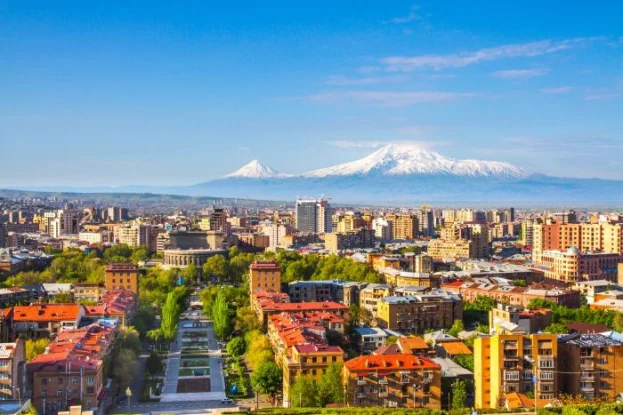
Source: KARTSIQ