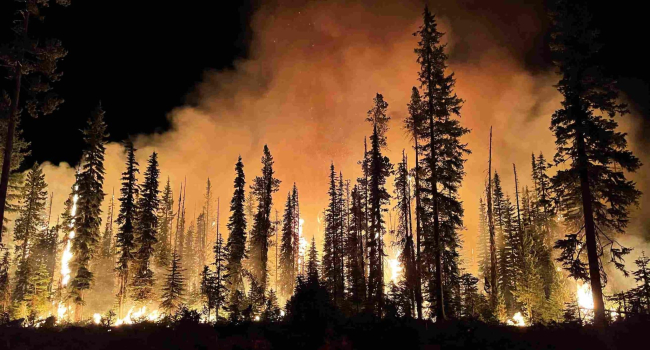
Scientists have found that smoke from forest fires is much more harmful to the body than exhaust gases and industrial emissions that damage the heart and lungs. Researchers from the Icahn School of Medicine at Mount Sinai Hospital, USA The team found that tiny particles of soot from wildfires cause more hospitalizations and deaths than the same amount of pollutants from other sources. Results of two large-scale studies were published in the journals Nature Communications and The Lancet Oncology. Researchers analyzed health data from millions of Americans in 20 states. They found that long-term exposure to smoke increases the risk of heart failure, asthma and pneumonia Risk of hospitalization due to Particularly troubling results came from a study of 414,016 elderly patients with lung cancer. although wildfire smoke accounts for only 4 percent of total pollution, it is responsible for 17 percent of all deaths related to exposure to PM2.5 particles. As senior author Yaguan Wei points out, smoke from wildfires is It is no longer a regional environmental problem, but has become a national health threat. He noted that PM2.5 particles from forest fires are much more toxic than equivalent air pollution from transport or factories. the level. The smallest PM2.5 particles are a mixture of microscopic solids and liquid droplets that can penetrate deep into the lungs and directly into the bloodstream. These pollutants cause chronic vascular inflammation and cause genetic mutations. A new study has shown that the chemical composition of wood soot has a more harmful effect on the cardiovascular and respiratory systems. Experts have found that low-income, low-educated city dwellers, already weakened by social inequality, are most vulnerable to wood soot blight. Due to climate change, the threat of forest fires is increasing every year. Haze affects regions thousands of kilometers away from the source of the fire. Cancer patients should be especially careful about air quality and avoid being outside during periods of smoke, scientists stressed, as even short-term exposure to a toxic environment can neutralize long-term treatment effects. The foods.
International News
The smoke of forest fires is more dangerous than the gases emitted in the metropolis. The Lancet
Source: KARTSIQ