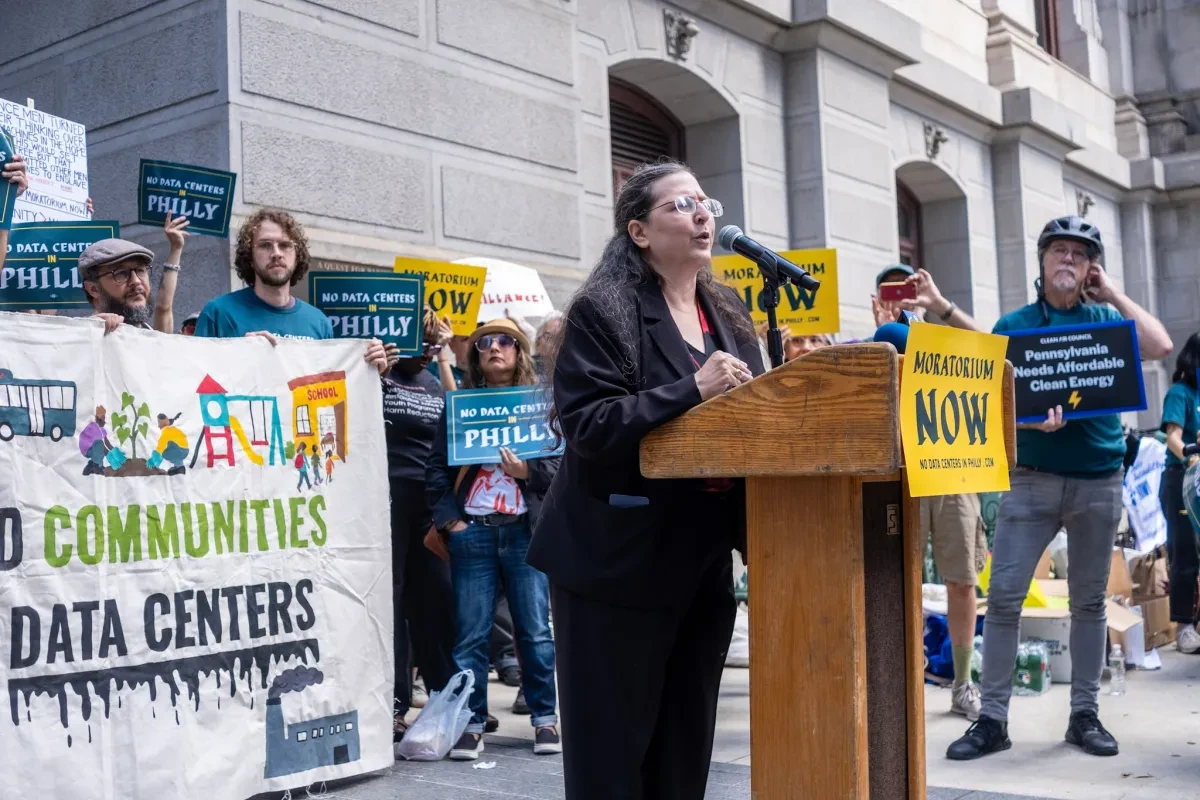
The rapid growth of artificial intelligence is creating a new conflict in the United States. Tech companies are building more and more data centers, promising jobs and economic growth, while city dwellers fear that Together with them, they will also get an additional burden on the energy system, water supply, the environment and their own health. This conflict is particularly acute in those regions that have lived in the vicinity of large industrial enterprises for decades. For those residents, the construction of another facility related to large volumes of energy and infrastructure is seen not as a symbol of technological progress, but as a return to a long-familiar past, reports TechCrunch. "We already know how this ends." One of the main figures of the movement against new data centers in Philadelphia has become Shomar Pitts, who has lived all his life in the Grays Ferry district in the southwest of the city. His childhood was spent in the neighborhood of Philadelphia Energy Solutions, one of the largest oil refineries on the East Coast. The plant processed up to 335,000 barrels of oil per day and was closed after a major explosion in 2019. Pitts remembers that for a long time he did not associate the chronic diseases of his relatives and neighbors with industrial pollution. In 2018, he became acquainted with activists from the environmental organization Philly Thrive, who were telling residents about the consequences of living next to a refinery. "My mother had this disease, my sister had another one, my neighbor had another one," Pitts told TechCrunch. After that, he joined the movement and today holds the position of co-executive director of Philly Thrive. Now the organization is in favor of a moratorium on the construction of data centers in Philadelphia. There are no official construction projects in the city yet, but the authorities have already identified two possible locations. One is in Northeast Philadelphia, the other in Grays Ferry, the very neighborhood that has lived next door to an oil refinery for decades. For local activists, not only the question of the scale of pollution is fundamental. They don't want the neighborhood to once again become a site for large-scale infrastructure, the consequences of which will be felt by residents for years. A data center is not a refinery, but it does require a lot of energy It would not be correct to directly compare a modern data center with an oil refinery. The Philadelphia refinery was a much larger industrial facility with an obvious impact on the environment. However, the artificial intelligence industry is rapidly increasing energy consumption, and this is what raises more and more questions. BloombergNEF predicts that by 2035, US data centers may consume more natural gas than Germany and Japan combined. Moreover, the new estimate is almost twice as high as the forecast that the company presented just nine months ago. Natural gas emits fewer pollutants when burned than oil, but it is still a fossil fuel and emits carbon dioxide. In addition, data centers need backup power supplies. According to environmental activists, a typical data center project in Pennsylvania can include hundreds of diesel generators. Officially, they are intended for emergency situations, but during high load of the power system, they are already recommended to be used to reduce the pressure on the power grid. This creates an additional problem. the more data centers appear, the higher the load on the infrastructure that must be maintained also at the expense of fossil fuels can become. According to Annie Fox, a lawyer at the Clean Air Council, increased demand from data centers could exacerbate climate change and, in turn, contribute to more frequent and severe heat waves when the power system is already overburdened. He is blessed. The big question is who will pay for the AI boom? For the residents of American cities, the debate over data centers is gradually turning from a question of technology to a question of resource allocation. Data centers require electricity, water and land. At the same time, companies promise new jobs and economic activity, but residents do not always see these benefits as sufficient compensation for the potential burden on infrastructure. At a rally in Philadelphia, local resident Donna Greenberg spoke not only about pollution, but also about water, electricity and privacy. According to him, he is concerned that the new facilities could use up resources that are needed by local neighborhoods. This problem goes far beyond the borders of Philadelphia. Protests against the construction of data centers are being held in various states, especially in places where local resources are limited or residents already have experience living near large industries. In some cities, the authorities have already started to introduce temporary restrictions. Moratoriums on the construction of data centers have been adopted, in particular, in Denver, Indianapolis, Asheville, Charlotte and Reno. Usually, the purpose of such restrictions is not to ban the technology entirely, but to give authorities time to study the possible consequences of construction and establish the necessary rules. In July, New York Gov. Cathy Hocully also signed an executive order temporarily barring the state from approving permits for large new data center projects. "Progress should not mean higher electricity bills, reduced water supplies or noise pollution," Hokul said. According to him, data centers should be built where they really want to see them. Why has the conflict become so acute right now? For residents like Pitts, it's not just about the specific building or the number of servers. This is a matter of trust. Neighborhoods that have already survived decades of living next to heavy industry know that the promise of economic benefit doesn't always mean the absence of long-term consequences. For this reason, the argument that AI data centers will create jobs and bring investment may sound significantly less convincing to such communities than to areas without such historical experience. More than a hundred people came to the first rally of the No Data Centers in Philly campaign in Philadelphia. Activists demanded to stop the possible placement of such objects in the city. At the same time, confrontation does not necessarily mean giving up the development of AI infrastructure altogether. The main question for local authorities and residents is where exactly to build it, what resources it will use, what environmental consequences are acceptable and who should bear the associated costs. The AI industry is still adding infrastructure at a pace that is difficult to compare with previous technology cycles. And now it faces a limitation that can't be solved solely with more powerful chips: local communities may simply not want to see new computing power near their homes. For Philadelphia, this story is particularly symbolic. A neighborhood that until recently lived next door to a huge oil refinery is now considering the possibility of next door to another era of infrastructure, not oil, but AI.
International News
Investments that may bring new problems. Why are AI data centers causing protests in American cities?
Source: KARTSIQ