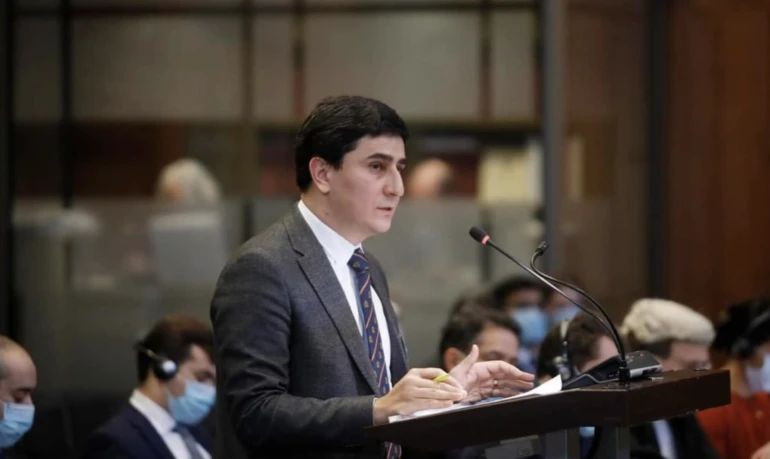
Criminalizing separation from territorial integrity is an object contrary to international law, because in general, the balance of international law was formed from the beginning based on the mutual parallel existence of those two principles. This was announced today, on October 16, at the international conference "Freedom, Justice and Recounting" by the former representative of RA on International Legal Affairs, head of YSU International Courts and Arbitration Master's Program. Ghishe Kirakosyan, referring to the accusations presented to the Armenian prisoners in Baku. "Territorial integrity and self-determination of peoples are two very important complementary principles. Sovereignty over the territory without the people becomes meaningless in general, because the meaning of sovereignty is primarily about people. If we focus only on the territory and generally (01:30) measure everything by it, we turn the entire international legal system upside down. Secondly, the trials conducted by Baku are illegal, it is pointless to even discuss it. I don't remember such a situation that in post-conflict situations justice will be done by one side. Naturally, in such cases, international courts take on a role. Today, many people say that international law does not exist, it is meaningless, but in my opinion, all those very pessimistic approaches kill international law. The states themselves should be interested in the logic of maintaining the international legal system. in all cases, the cost of these trials and the cost of the decisions made is quite high. It creates an opportunity to confront the war of narratives, which are often very aggressive, especially in the case of countries with a history of conflict like ours. When you don't have an international platform where you can present any form of argument, evidence and truth, you lose. But I am sure that the transformation of this legal system will lead to some logical next step, because it cannot be a legal system in general. I think that the turbulent period will pass in a few years, the same system will be reinterpreted, and by that logic, the connection of countries like ours with the international legal system will be constantly re-established and the people involved in it. "It is very important," Yeghishe Kirakosyan said, highlighting the claims presented by Armenia in international courts in this context. "They also have important political significance, because if they did not have political significance, they would not become the subject of discussion."
International News
There are illegal trials in Baku, it would be naive to expect any guarantee from them. Yeghishe Kirakosyan
Source: KARTSIQ