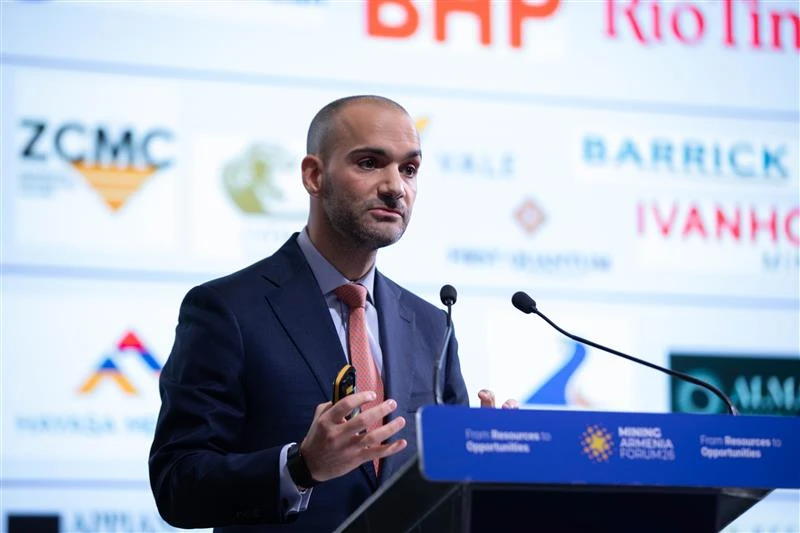
Armenia has significant geological potential and human resources necessary for the development of the mining industry, but in order to attract international investments, the country needs to improve the quality of geological data, strengthen public increase confidence in the sector and increase the transparency of the legal system. Vael Jaber, vice president of Wood Mackenzie's mining and metallurgy consulting division, announced this while speaking at the Mining Armenia Forum 2026 sector conference. According to him, the results of the Wood Mackenzie research showed that investors positively assess the geological potential of Armenia, as well as the personnel, knowledge and professional skills necessary for work in the mining industry. Access to information. "The good news is that there is potential, there is geology," said Jaber, pointing to the country's initial advantages. According to him, Armenia has the basis on which the sector can be developed. At the same time, assessments of the country's capabilities in related directions were not clear. Among the most problematic factors, Jaber singled out two: the low quality of the geological database and the state of public agreement formed around the mining industry. The first question is directly related to the information that potential investors are guided by when evaluating deposits and making investment decisions. Insufficient completeness or quality of geological data makes it difficult to assess project prospects and increases uncertainty for companies considering the possibility of operating in Armenia. It is. The second factor concerns the relationship between the mining business and society. For the development of the sector, it is important for its activities to be perceived as legitimate, and for the conditions of project implementation and the obligations related to them to enjoy public trust. At the same time, Jaber emphasized that the identified shortcomings should not be perceived as insurmountable limitations. According to his assessment, these are directions in which it is possible to achieve improvements thanks to targeted actions. He expressed hope that in the case of consistent work on the identified problems, the results of a similar survey after a year could show a reduction in the number of negative evaluations and an increase in positive ones. The expert paid special attention to the geographical position of Armenia. According to him, this factor occupies an intermediate place in investors' assessments. it is definitely not perceived as an advantage or as a disadvantage. Jaber admitted that Armenia can be considered as a country in a geographically limited position. However, in his opinion, it is important to understand how to use the country's regional position for the development of economic ties. In particular, he pointed out the opportunities related to neighboring states, Armenia's transit position and the prospect of forming transport corridors in the region. According to him, the problem lies in the fact that the geographical features of the country should be turned into a factor contributing to the development of the sector, rather than a factor restraining it. For that, it is necessary to decide which of the existing conditions can be improved and how to use them to strengthen Armenia's competitive position. The expert emphasized that intermediate factors are especially important when developing a strategy. if approached competently, they can move into the category of advantages and help the country stand out from other sources of investment in the mining sector. in the background of sorrows. Wood Mackenzie's research on public administration also gave mixed results. Among the positive factors, market participants noted Armenia's openness to investors and the relative simplicity of doing business. Jaber clarified that these assessments are only partially true, but in general, the perception of the country in these directions remains favorable. At the same time, the most serious concerns are related to the transparency of the legal system and the practice of applying legislation. According to the expert, investors do not appreciate the transparency of the legal environment and law enforcement practice in Armenia. This raises additional questions for companies that need to understand how predictable the rules of operation will be, the protection of their interests and the fulfillment of established requirements. Jaber stressed that geological advantages cannot compensate for the shortcomings of state administration. Even with the presence of prospective deposits, the country must form appropriate institutional conditions to attract international business. "It is necessary to change the approaches. It is real, it can be done," he stated, speaking about the possibility of eliminating the identified shortcomings. According to his assessment, for this, it is necessary not only to define the problematic directions, but also to draw appropriate conclusions, and then implement concrete changes. In the results of the research, a special place was occupied by the fiscal regime: the conditions of taxation and other financial parameters that determine the economics of mining projects. Jaber placed it among the factors requiring improvement and drew attention to the fact that the state can achieve relatively quick results in this area. According to him, the change of geological conditions or the development of geological exploration require considerable efforts and time. And the adjustment of fiscal instruments, on the contrary, can be carried out much faster. "Fiscal funds can be invested quickly enough, and the country will become more attractive," explained the expert. He noted that changes in this area can quickly affect the perception of Armenia by international investors. The state can show its willingness to improve the conditions for business through specific decisions, and not only through statements about the intention to develop the sector.
Armenia
RA's geological potential is attractive to investors, but there are data and enforcement issues
Source: KARTSIQ