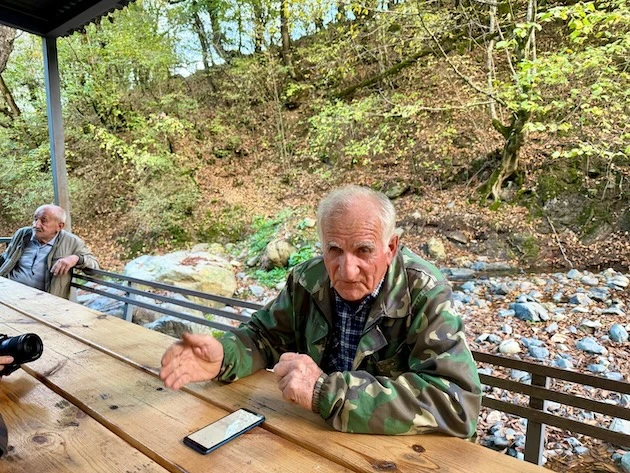
In an article prepared for the Inter Press Service (IPS) news agency, journalist Stella Paul presents how the militarization of the Armenian-Azerbaijani border threatens the unique ecosystems of the Shikahoghi State Reserve in the south of Armenia. On October 22, the journalist visited the reserve and found himself less than 100 meters away from the military positions located on opposite sides of the border. While observing the surrounding landscape, his attention was attracted not so much by the presence of the military, but by the absence of trees. Large parts of the hillsides were devoid of vegetation, violating the integrity of the forest cover. The territory of the Shikahoghi State Reserve, founded in 1958, is about 30 thousand acres, about 94 percent of which is covered by forests. Caucasian leopard, bezoar goat and brown bear live here. More than 1100 species of plants grow in the reserve, 70 of which are included in the Red List of the International Union for Conservation of Nature. The representatives of the Armenian side connect the environmental changes with the militarization of the border areas. Kapan Deputy Mayor Marat Harutyunyan noted that these changes became more visible after the 2022 military operations. According to him, the Azerbaijani forces cleared some parts of the forest in order to deploy military positions and build access roads. At the same time, the full scope of these works has not been confirmed by independent sources. The consequences of militarization affect not only nature, but also the daily life of local residents. According to Harutyunyan, the Azerbaijani forces occupy a number of heights, from which the reserve and neighboring settlements are visible. People are afraid to visit some areas because of the danger of mines. Local farmer Vladik Aghatelyan told the journalist that he lost two cows as a result of the mine explosion. Due to many risks, he had to give up cattle breeding. Other farmers also no longer graze cattle in areas close to the forest. The decrease in income forces residents to look for additional sources of employment. The fate of wild animals is of particular concern. Retired veterinarian Manvel Arzumanyan remembers that in the past bears, wild goats and other animals roamed freely in the forests and mountains of the region. This area was an important ecological corridor that connected the habitats of animals in Armenia, Azerbaijan and Iran. Harut Marzinyan, a zoologist at the Shikahoghi State Reserve, confirmed that the conflict makes it difficult to conduct field research and monitor the movement of animals. According to him, the expansion of roads, the development of military infrastructures and the fragmentation of natural habitats can disrupt ecological corridors and isolate animal populations. However, due to security issues and restrictions on access to some areas, it is not possible to carry out comprehensive research. The problem goes beyond the South Caucasus. Experts note similar consequences in the context of ongoing armed conflicts in Lebanon, Gaza and Ukraine: destruction of forests, pollution of land and water resources, destruction of habitats of wild animals. and threats to food security. Despite the growing facts about the damage caused to nature as a result of wars, the issue of special financing mechanisms for the restoration of war-damaged ecosystems is hardly discussed in the framework of the COP17 being held in Yerevan. The main conclusion of the article is that the protection of biodiversity is inseparable from issues of security and the environmental consequences of armed conflicts. Those consequences are already visible in Shikazhol. trees are disappearing, access to land is limited, and local residents are losing the opportunity to maintain their traditional way of life and economy.
Armenia
How conflict is pushing biodiversity to the brink
Source: KARTSIQ